
History
Who Broke the Sound Barrier? Chuck Yeager, the Bell X-1 and 14 October 1947
Loui Chen
October 14, 2026
11
min read

Chuck Yeager beside the X1, nicknamed the "Glamorous Glennis".
Charles E. “Chuck” Yeager was the man who broke the sound barrier. History was made on the 14th October 1947. For the first time, a man named Charles E. “Chuck” Yeager, flew faster than the speed of sound. On that historic day, US Air Force Captain Charles E. “Chuck” Yeager flew a Bell X-1, nicknamed the Glamorous Glennis, an experimental rocket-powered aircraft which he piloted to Mach 1.06 – breaking the sound barrier.
The aircraft was carried to the Mojave Desert in California strapped under a B-29 Bomber. When the B-29 got to an altitude of 20,000 feet, a journey that took 30 minutes, the X-1 was released. The X-1 then climbed 42,000 feet to begin its ninth powered flight. This would then become a legendary flight to be remembered – the first piloted aircraft, the first human, to ever fly faster than the speed of light.
Yeager flew with the power of the XLR-11 rocket engine for just 20 seconds before gliding down to Rogers Dry Lake, landing safely. The moment from when the X-1 was released from the B-29 to when it landed lasted a total of 14 minutes.
In our article, we’ll go over some details on the Bell X-1 and Charles E. “Chuck” Yeager’s legacy as a pilot.
How fast was the Bell X-1 “Glamorous Glennis”?
On that historic day of 14th October, 1947, the Bell X-1 reached Mach 1.06 (700mph) at an altitude of 7,000 meters, or 23,000 feet. However, the aircraft flew a total of 78 times and went beyond just Mach 1.06.
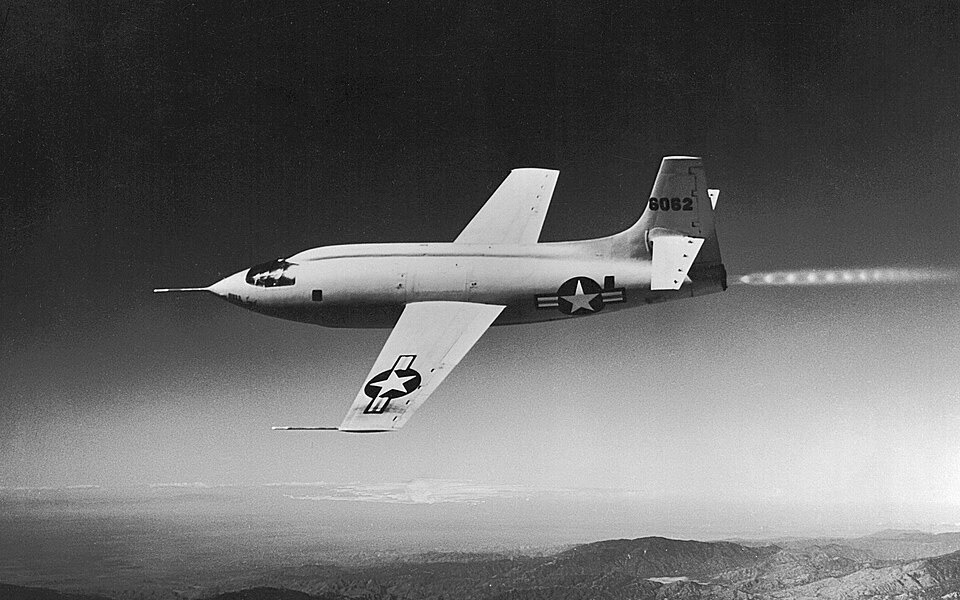
On 26th March 1948, the Bell X-1 broke Mach 1.45 (957mph) at an altitude of 21,900 meters, or 71,900 feet – less than half a year later, yet again with Yeager in the cockpit of the Bell X-1.
At the time, this was the highest velocity and altitude a piloted aircraft had ever reached.
Why was the Bell X-1 built?
Initially named XS-1, the Bell X-1 was built as a part of a program in 1944 between NASA’s predecessor NACA (National Advisory Committee for Aeronautics) and the U.S. Army Air Forces, which would later just be known as the U.S. Air Force.
The goal for this program was to build a manned research aircraft that could reach both transonic speeds, and more ambitiously at the time, supersonic speeds.
The intent behind building the X-1 is not for one definitive reason but as a result of a multitude of issues aircraft designers had faced. In the 1930s and 1940s, aircrafts began experiencing very undesirable issues such as compressibility, excessive drag, loss of control, and severe turbulence. Moreover, with wind tunnels unable to provide reliable data on these issues, the burgeoning idea of the X-1 was came to John Stack of NACA, Erza Kotchner of the Air Forces, and Walter Diehl of the Navy, when the realisation that only a research aircraft would offer a feasible way to get the supersonic and aeronautical data that was needed.
The design behind the Bell X-1
The dimensions of the aircraft were 326.4cm x 937.3cm x 853.4cm and it weighed 2780.5kg.
Fuselage of the X-1 aircraft was purposefully designed to be in the same shape of a .50 caliber bullet – the reasoning behind this was that bullets retain their stability, even at supersonic speeds. The Bell X-1’s wings were also extremely thin and strong for the standards at the time and straight rather than swept back.
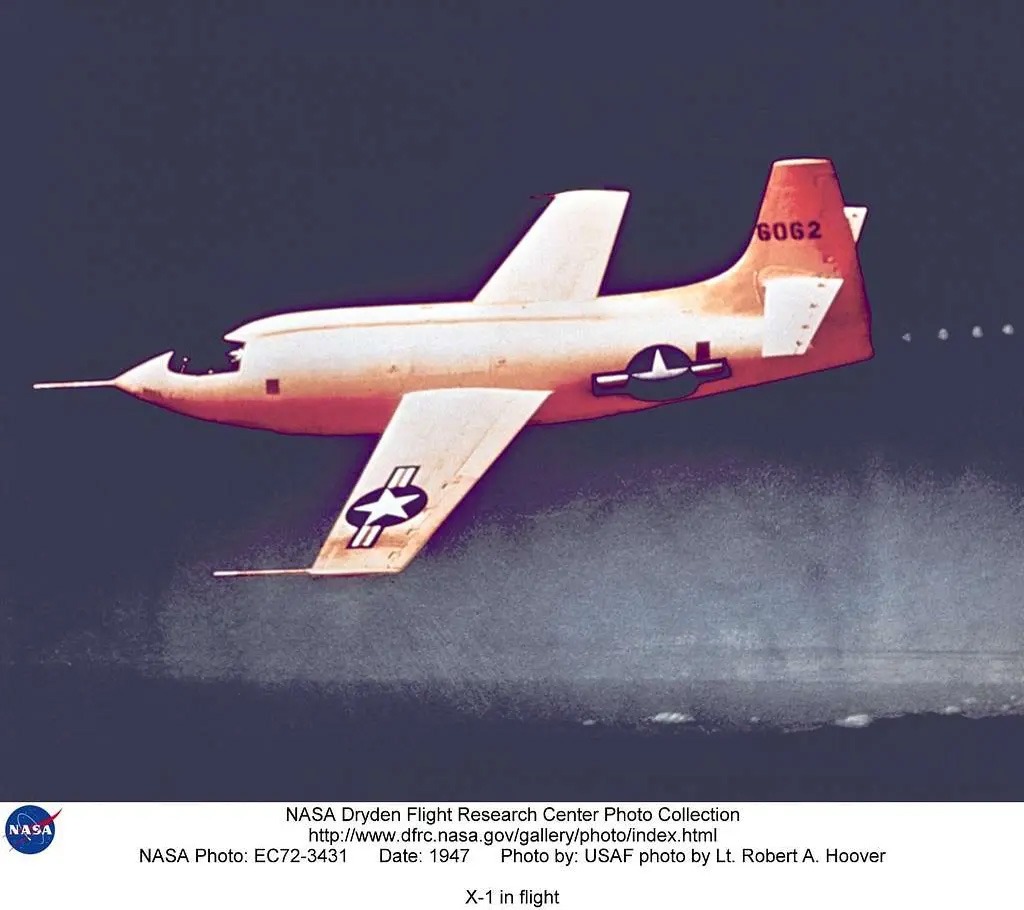
Early attempts had seen extreme aerodynamic buffeting as the Z-1 approached the “Sound Barrier”. So engineers upgraded the adjustable horizontal stabilisers to allow for instant incremental changes in angles of attack – this increased control and the changes allowed the aircraft to smooth the airflow through angular adjustments as it approached the speed of sound – greatly helping to maintain the elevator effectiveness of the aircraft.
The Bell X-1 was also fitted with a four-chambered XLR-11-RM-3 rocket engine which provided 26,500 newtons of static thrust.
Who broke the sound barrier? Really?
Whilst Charles E. “Chuck” Yeager and the Bell X-1 is officially recognised and credited as the first human being and aircraft to have broken the sound barrier, there are disputed claims on the topic of who broke the sound barrier first – Chuck Yeager on the 14th October, or George Welch, just two weeks prior?
The first supersonic flight that people often speculate on features George Welch as previously mentioned – in a XP-86 Sabre in a steep, nose-dive (rather than in level-flight as Yeager performed officially in the X-1). Both the XP-86 and X-1 were Air Force programmes.
Although he had served in the military from 1939–1944, he resigned as a major, and Welch became a civilian test pilot with North American Aviation under the recommendation of his General, Hap Arnold.

His rumoured supersonic flight occurred on the 1 October 1947, just prior to this flight, he had reportedly told the hostess, Millie Palmer, of the Happy Bottom Riding Club (a bar, local to the California’s Edwards Air Force Base where Yeager and Welch’s was centered around) to listen out for a shockwave from his impending maiden flight on the XP-86 from the Muroc North Base test facility where they also were testing the Bell X-1.
Welch has never publicly claimed to have been the one who broke the sound barrier first. In fact, the claim that this flight broke Mach 1, mainly comes from Al Blackburn, a test pilot who joined North American Aviation in 1954, in his book Aces Wild: The Race for Mach 1 which was released in 1998, Blackburn claims that on the Muroc radar theodolite recorded two flights by George Welch that broke supersonic speeds prior to 14 October 1947, alongside a sonic boom being allegedly heard over the desert, just 20 minutes before the X-1 claimed the record.
Al Blackburn in his book states: “We know for certain that North American test pilot George Welch took the Sabre supersonic prior to November 13, 1947. Whether this occurred before the X-1’s historic flight of October 14, readers of the narrative may decide for themselves.”
However, this claim is highly debated, due to Welch’s own complaint that the J35 engine lacked enough power (which would later be replaced by more powerful J47 engines). Another issue that is brought up is that on the XP-86’s first flight, Welch encountered an issue with the main landing gear and nose gear which was reported in a North American report to the Air Force. As the gear issues occurred almost immediately after takeoff, it’s argued that Welch would not have had the time to perform a Mach 1 flight.
Why wasn’t George Welch’s alleged first supersonic flight credited?
Whether or not George Welch or Chuck Yeager was the first person who broke the sound barrier is highly debated – however, we can at least acknowledge that Chuck Yeager’s flight on the X-1 was the first verified, acknowledged, reported, and controlled supersonic flight.
So why wasn’t any of George Welch’s, alleged supersonic flights, recorded?
The Smithsonian magazine refers to a report in the National Archives that suggests that NACA did not collect any data on the XP-86 until 1948. Reporting that North American Aviation was concerned that there were shock waves forming around the wingtip boom of the XP-86, which would make pressure readings and measurements inaccurate and erroneous.
Al Blackburn, the author and test-pilot in defense of his claim that George Welch was the first person to fly a supersonic flight, claims more political reasons. He claimed that Stuart Symington, at the time, Secretary of the Air Force had strictly issued a directive to North American Aviation to not break the sound barrier before the X-1 was able to. The suggestion is that Symington wanted the win for the first official supersonic flight to be under the record of the US Air Force and under an official military pilot rather than a civilian test pilot and fighter jet prototype – perhaps to avoid political embarrassment for the US Air Force.
While this claim is not backed up by any sources by Blackburn, it is not a completely ridiculous claim as both the XP-86 and X-1 were Air Force programmes and it is reasonable to assume that Symington had influence over high-value production contracts with North American Aviation which gives him the leverage to put the directive in place.
Since these claims from Blackburn are debated and not officially verified, whether the directive was a true-event, remains obscure and unsubstantiated.
We can conclude that, whether or not the XP-86 did hit supersonic speeds, no official record of it doing so exists – particularly prior to 1948, when accurate reports on the aircraft could be made.
Who was Charles E. “Chuck” Yeager?
Born in 1923, in West Virginia, Charles E. Yeager – otherwise known as Chuck Yeager – was an extraordinary pilot, test pilot, and United States Air Force Brigadier General.
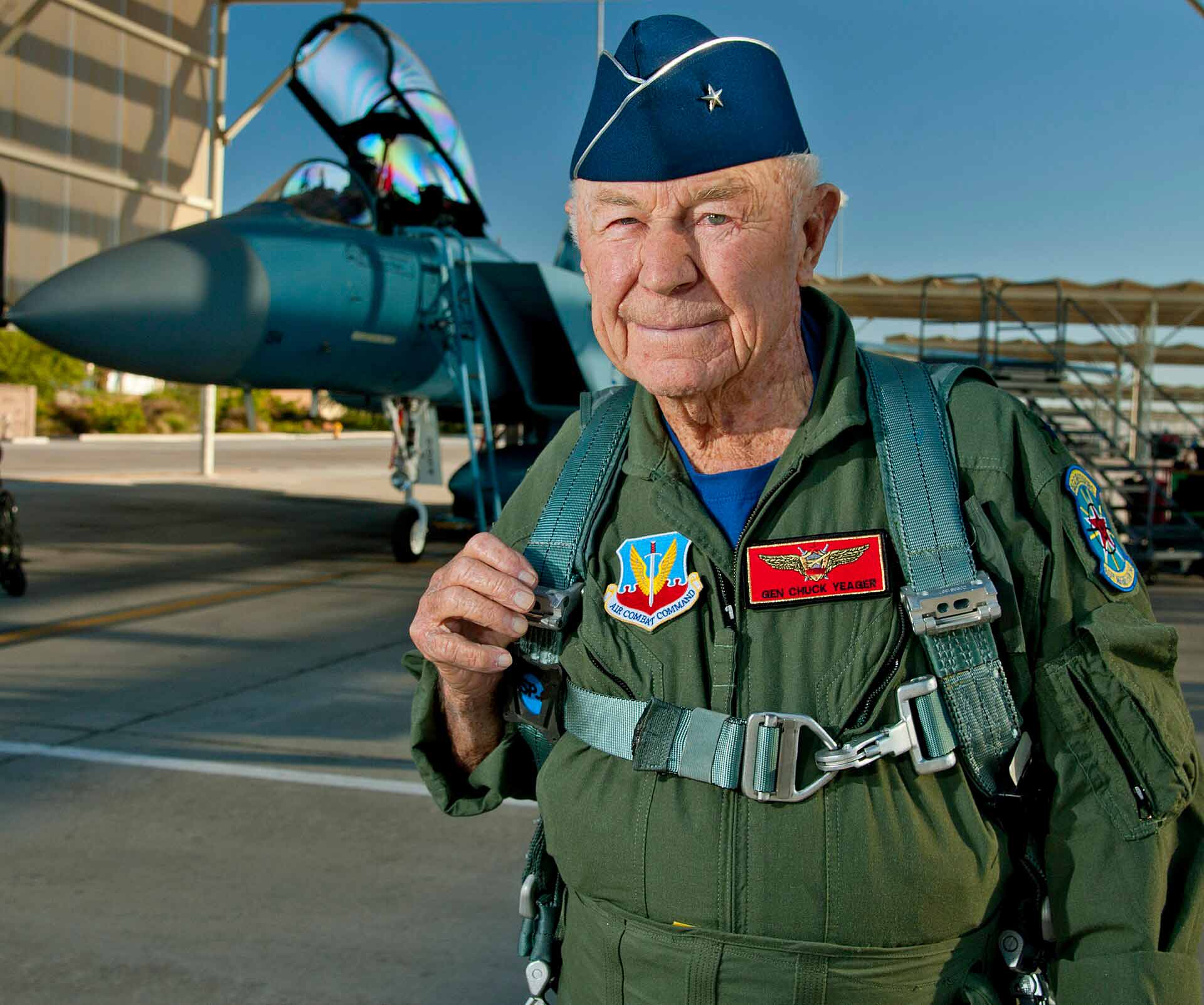
Chuck Yaeger’s career
We’ll give a quick summary of his military career, before delving into more detail:
- Private, Army Air Corps, September 1941
- Private first class to corporal, Army Air Forces, 1941 – 1943
- Flight officer, Army Air Forces, March 1943
- Second lieutenant, Army Air Forces, July 1944
- First Lieutenant, Army Air Forces, September 1944
- Captain, Army Air Forces, October 1944
- Second lieutenant, Army Air Forces, February 1947 (due to post-WWII military demobilisation and reorganisation, was reappointed and backdated to his position in 1944)
- First lieutenant, Army Air Forces, July 1947
- Captain, United States Air Force, July 1951
- Major, United States Air Force, began in February 1951 temporarily, permanently in July 1958
- Lieutenant colonel, United States Air Force, began in March 1956 temporarily, permanently in August 1964
- Colonel, United States Air Force, began in March 1961 temporarily, permanently in September 1967
- Brigadier general, United States Air Force, June 1969
Yeager enlisted in the Army Air Corps in 1941 and enrolled into pilot training under the flying sergeant program in 1942. In 1943, he was appointed flight officer and received his pilot wings.
General Yeager quickly showed his aerial combat abilities in France and Germany during 1943–1945 of World War II – shooting down 13 enemy aircrafts before being shot down himself in 1944 over occupied France, only managing to escape capture when the French Maquis helped him to reach the Spanish border to relative safety.
Returning to the USA in 1945, he became an instructor pilot before going to Ohio for his first experimental flight test work. This eventually led to his work piloting the Bell X-1 in California where he became known as the first man to fly faster than the speed of sound. As a test-pilot, he also flew the Bell X-IA during 1953, becoming the first to fly more than twice the speed of sound in level flight.
In 1952, he attended the Air Command and Staff College before returning to Europe in 1954, and in 1955, becoming commander of the 417th Fighter Squadron at Hahn Air Base in Germany until his squadron was reassigned to Toul-Rosieres Air Base in France in 1956.
In the following year, he returned to the United States, assigned to the 413th Fighter Wing in California, then became commander of the 1st Fighter Squadron where he went to Moron Air Base in Spain until 1958. With the same unit which was later designated as the 206th Tactical Fighter Squadron, he returned to The George Air Force Base in California.
In 1961, General Yeager graduated from Air War College in Alabama and became the commandant of the Aerospace Research Pilot School which is where all military astronauts are trained in 1962.
When he became commander of the 405th Fighter wing in 1966 at Clark Air Base in the Philippines, he flew 127 missions in South Vietnam. In 1968 he went with the 4th Tactical Fighter Wing, which he commanded at the time, to Korea during the Pueblo crisis.
After that, in 1969 and 1971 respectively, he became vice commander to the Seventeenth Air Force, headquartered at Ramstein Air Base in Germany, and then became the United States defense representative to Pakistan. Then, reporting to the Air Force Inspection and Safety Center in March 1973 at Norton Air Force Base in California before becoming the director of the center in June just a few months later.
In 1975, Yeager retired from the Air Force.
What are Chuck Yeager’s awards & decorations?
Yeager was highly decorated and acknowledged for his numerous contributions not only in his military career but also towards aviation as a whole.
A list of Chuck Yeager’s personal decorations:
- Air Force Distinguished Service Medal (this was awarded in 1975 in his retirement.)
- Distinguished Service Medal
- Silver Star with bronze oak leaf cluster (this was awarded for shooting down 5 Messerschmitt Bf 109s in a single day.)
- Legion of Merit with bronze oak leaf cluster
- Distinguished Flying Cross with two bronze oak leaf clusters (this was awarded for being the first to break the sound barrier.)
- Bronze Star Medal with a bronze “V” device (valor device awarded for rescuing a fellow wounded airman from the steepest part of the Pyrenees in Nazi Germany occupied France.)
- Purple Heart
- Air Medal with two silver oak leaf clusters
- Air Force Commendation Medal
- Presidential Medal of Freedom (bestowed by Ronald Reagan)
A list of Chuck Yeager’s unit awards:
- Presidential Unit Citation with bronze oak leaf cluster
- Air Force Outstanding Unit Award
A list of Chuck Yeager’s campaign and service medals:
- American Defence Service Medal
- American Campaign Medal
- European-African-Middle Eastern Campaign Medal with one silver and one bronze service star
- World War II Victory Medal
- Army of Occupation Medal with a Germany clasp
- National Defense Service Medal with star
- Armed Forces Expeditionary Medal
- Vietnam Service Medal with two campaign stars
- Air Force Longevity Service Ribbon with one silver and one bronze oak leaf clusters
- Air Force Small Arms Expert Marksmanship Ribbon
A list of Chuck Yeager’s ‘foreign’ awards:
- Tongil Medal of the South Korean Order of National Security Merit
- Chevalier of the French Legion of Honour
- Republic of Vietnam Gallantry Cross Unit Citation
- Republic of Vietnam Campaign Medal
Largely acknowledged in aerospace, Yeager was inducted into both the International Air & Space Hall of Fame, as well as the International Space Hall of Fame respectively in 1966 and 1981.
In 1973, Yeager was inducted into arguably aviation's highest honor, the National Aviation Hall of Fame (NAHF). In the following year, he also received, at the American Academy of Achievement, the Golden Plate Award.
President Gerald Ford also presented Yeager with a silver medal equal to the non-combat Medal of Honor for his test-pilot activities for the X-1 research. This was presented at a ceremony in the White House in 1976.
Why was Chuck Yeager chosen to test the Bell X-1?
Chuck Yeager was chosen to be the test pilot for the Bell X-1 by Albert Boyd rather unexpectedly. Though he was very qualified as a pilot, he was not Boyd’s most senior test pilot. He was described to have an ability to convey subject flight characteristics into performance data for engineers that monitored his flights.
Colonel Albert Boyd (later, Major General) directed the Army Air Forces test programme for the Bell X-1, considered a primary driving force in the 14 October 1947 flight by Chuck Yeager, who broke the sound barrier.
After Boyd shifted the programme ‘in-house’, endeavouring to use military pilots due to disputes with civilian contract pilots from Bell Aircraft, Boyd selected Chuck Yeager to be the test pilot in June 1947. His choice to enlist Yeager in this programme was unconventional as Yeager was his most junior test pilot at the time. However, Boyd had trusted Yeager with this position as he was the best instinctive pilot he knew, and, due to his capacity to keep his cool and focus during incredibly stressful situations. And the Bell X-1 programme? It was certainly stressful due to long standing beliefs that breaking the sound barrier was truly an impossible feat.
Frequently asked questions (FAQs) on the topic
Who was the first person to break the sound barrier?
Chuck Yeager was the first person to officially break the sound barrier on October 17, 1947 at Mach 1.06 over Muroc Dry Lake, California. Becoming the first to achieve sustained, level, supersonic flight.
What was the first plane to break the sound barrier?
The Bell X-1, previously known as the XS-1 and alternatively nicknamed the Glamorous Glennis, was the first aircraft to break the sound barrier. It was a bullet-shaped aircraft, utilising rocket engines and fuel – airdropped by a modified B-29 bomber.
Why was the Bell X-1 dropped instead of taking off?
The X-1 was air-dropped from a B-29 to conserve rocket fuel as the engine only had approximately 2.5 minutes of burn time, so air-dropping allowed it to reserve power for the flight to supersonic speed.
Is it true that Chuck Yeager broke the sound barrier with broken ribs?
Two days before the historic flight, Yeager had broken two ribs after an accident while horseback riding. He hid his injury and only confided in Jack Ridley, his friend and aeronautical engineer on the X-1 programme. Because his injury made it impossible for Yeager to properly seal the X-1’s cockpitch hatch, Ridley would then saw off a broomstick handle for Yeager to use as a lever to seal the door.
Metric
More on this aircraft
Dispatch
More in your inbox.
Written by

Loui Chen
Researcher, Jetify
Loui Chen is a researcher for Jetify and has worked in its parent group since 2021. She researches the aircraft, operators and flight locations covered in the Jetify journal, and checks specifications, histories and booking details against operator and published sources before an article goes live.
LinkedInRead next