
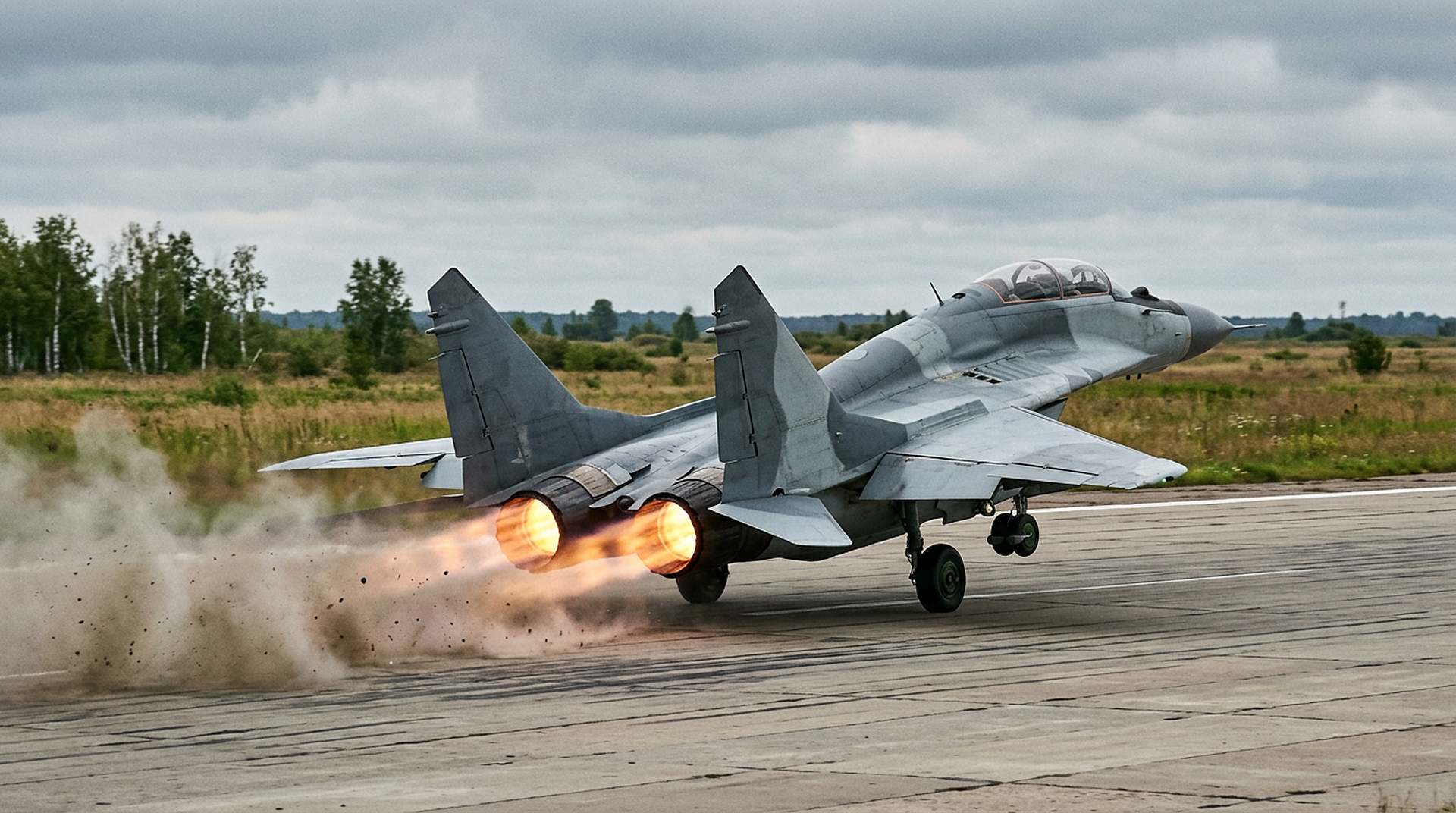
Aircraft comparison
MiG-29 Fulcrum vs F-16 Fighting Falcon
The Cold War’s best-known lightweight fighter matchup. Compared on close-range combat, sensors, controls and timeline, from US Air Force sources.
Updated October 2026 · 2 minute read
Is the MiG-29 better than the F-16?
On the evidence of the US Air Force’s own museum, the F-16 was the more advanced design and the MiG-29 the more dangerous opponent at close range. The MiG-29 arrived later, with deliveries from 1983 against 1979 for the F-16A, and its first versions had no fly-by-wire controls. Its helmet-mounted sight, though, let a pilot aim a missile simply by turning his head.
MiG-29 Fulcrum
Helmet-mounted sight · Off-boresight missile aiming · Infrared tracking
F-16 Fighting Falcon
Fly-by-wire controls · Earlier into service · Cockpit design
MiG-29 vs F-16 specifications
F-16 figures are from the US Air Force fact sheet for the F-16C/D. MiG-29 details describe the early MiG-29A; no MiG-29 performance figures are given because none could be verified to the standard used on this page.
MiG-29 Fulcrum
F-16 Fighting Falcon
Advantage
Role
MiG-29 Fulcrum
Multirole
F-16 Fighting Falcon
Multirole
Advantage
—
First flight
MiG-29 Fulcrum
1977
F-16 Fighting Falcon
1974 (YF-16), 1976 (F-16A)
Advantage
—
In service
MiG-29 Fulcrum
1983 (deliveries)
F-16 Fighting Falcon
1979
Advantage
—
Top speed
MiG-29 Fulcrum
Mach 2.25 (2,446 km/h)
F-16 Fighting Falcon
Mach 2 (2,414 km/h)
Advantage
MiG-29
Supercruise
MiG-29 Fulcrum
None
F-16 Fighting Falcon
None
Advantage
—
Service ceiling
MiG-29 Fulcrum
18,013 m
F-16 Fighting Falcon
15,240 m
Advantage
MiG-29
Combat radius
MiG-29 Fulcrum
720 km
F-16 Fighting Falcon
546 km
Advantage
MiG-29
Engines
MiG-29 Fulcrum
2 × Klimov RD-33
F-16 Fighting Falcon
1 × Pratt & Whitney F100 or GE F110
Advantage
—
Thrust vectoring
MiG-29 Fulcrum
No
F-16 Fighting Falcon
No
Advantage
—
Radar cross-section
MiG-29 Fulcrum
Conventional
F-16 Fighting Falcon
Conventional
Advantage
Even
Sensor fusion
MiG-29 Fulcrum
Limited in original version
F-16 Fighting Falcon
Upgraded on later blocks
Advantage
F-16
Air-to-ground
MiG-29 Fulcrum
Limited, better in SMT variants
F-16 Fighting Falcon
Primary role
Advantage
F-16
Carrier capable
MiG-29 Fulcrum
Yes (MiG-29K)
F-16 Fighting Falcon
No
Advantage
MiG-29
Short take-off
MiG-29 Fulcrum
No
F-16 Fighting Falcon
No
Advantage
—
Cost per unit
MiG-29 Fulcrum
$22 million
F-16 Fighting Falcon
$25 million
Advantage
MiG-29
Number built
MiG-29 Fulcrum
1,600+
F-16 Fighting Falcon
4,600+
Advantage
F-16
Exportable
MiG-29 Fulcrum
Yes, 25+ air forces
F-16 Fighting Falcon
Yes, 26 air forces
Advantage
Even
Combat record
MiG-29 Fulcrum
Gulf War, Balkans, Ukraine
F-16 Fighting Falcon
Extensive, many conflicts
Advantage
—
Close-range combat
The MiG-29's pilot wore a helmet-mounted aiming device. Instead of pointing the aircraft at a target and waiting for the missile to lock on, he turned his head and the helmet aimed the missile's sensors. The National Museum of the US Air Force says this "off boresight" method gave the MiG-29 pilot a great advantage at close range.
The F-16 was built around its pilot in a different way. It has a side stick controller instead of a centre-mounted stick, and its seat-back is angled at 30 degrees instead of the usual 13.
Winner
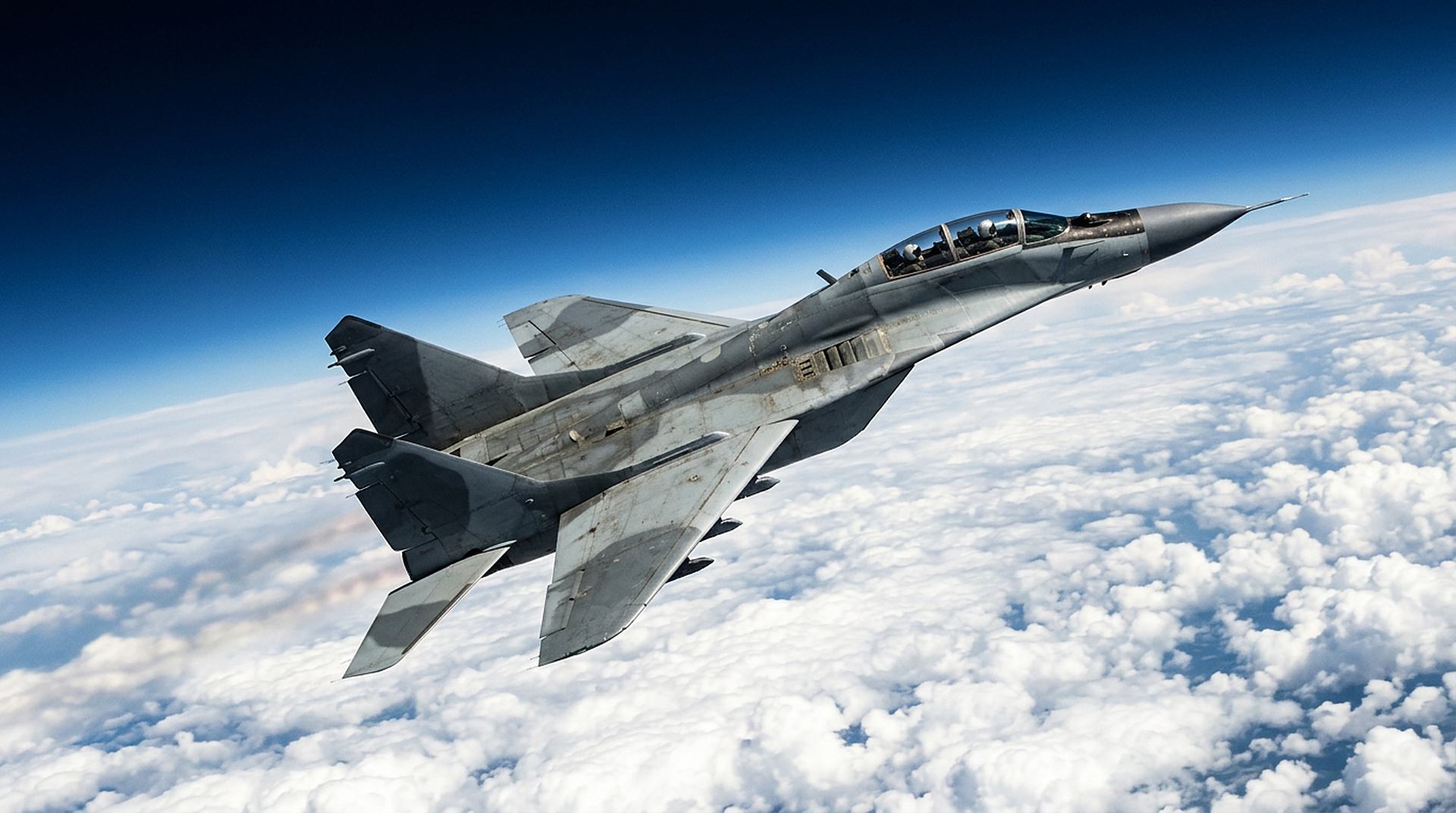

Sensors and controls
The MiG-29A's N019 Doppler radar could detect a target more than 97 km (60 miles) away. With infrared tracking sensors and a laser rangefinder as well, its pilot could track and shoot at aircraft flying below him, which earlier Soviet fighter radars could not do reliably.
Flight controls were the F-16's advantage. Its fly-by-wire system relays the pilot's commands through electrical wires. The first MiG-29 versions used a conventional hydraulic system and an aluminium alloy fuselage.
Winner
Performance
The US Air Force lists the F-16 at 2,414 km/h (1,500 mph), which is Mach 2 at altitude, with a ceiling above 15 kilometres (50,000 feet). It has one engine of 27,000 pounds thrust, a 20mm cannon with 500 rounds, and external stations for up to six air-to-air missiles.
No equivalent figures are given here for the MiG-29. Published numbers vary, and none could be checked against a primary source for this page.
Winner

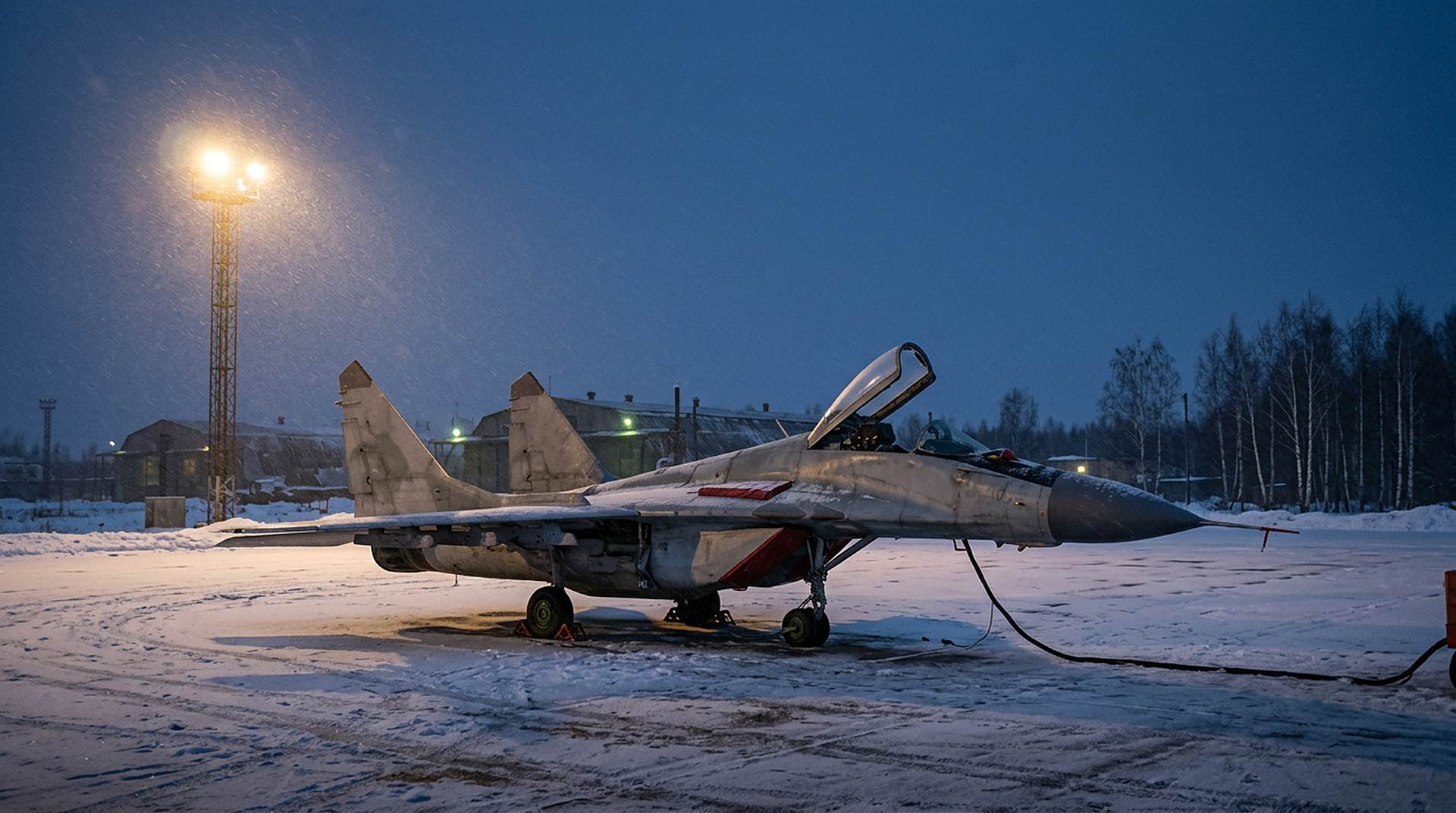
Timeline
MiG's designers started work in the early 1970s. The first prototype flew on 6 October 1977, production began in 1982 and deliveries followed in 1983.
The F-16A first flew in December 1976, and the first operational aircraft was delivered in January 1979. The F-16 was in service four years before its Soviet counterpart.
Winner
Why these two are compared
Built as an answer
The MiG-29 was designed in response to a new generation of American fighters that included the F-15 and the F-16.
Air defence first
The MiG-29 was an air defence fighter that also had a ground attack capability. The US Air Force classes the F-16 as a multirole fighter.
A moving target
Later MiG-29 variants added some fly-by-wire controls and composite materials, so comparisons depend heavily on which versions are being compared.
Can a civilian fly either aircraft?
No. The F-16 is a frontline military aircraft, and MiG-29 flights are not currently bookable through Jetify.
Jetify's flights use ex-military jets instead. See the fighter jet flights page for the aircraft and locations currently listed.
MiG-29 vs F-16 questions
Is the MiG-29 Fulcrum better than the F-16?
Whether the MiG-29 Fulcrum or the F-16 is better depends on the fight. The National Museum of the US Air Force describes the MiG-29 as a dangerous opponent at close range, thanks to its helmet-mounted sight. The F-16 had the more advanced flight controls, with fly-by-wire from the start.
Which came first, the MiG-29 Fulcrum or the F-16?
The F-16 came before the MiG-29 Fulcrum. The F-16A first flew in December 1976 and the first operational aircraft was delivered in January 1979. The first MiG-29 prototype flew on 6 October 1977, and deliveries began in 1983.
What gave the MiG-29 Fulcrum its advantage at close range?
The MiG-29 Fulcrum’s advantage at close range came from its helmet-mounted sight. The pilot could aim a missile by turning his head, rather than pointing the whole aircraft at the target. The National Museum of the US Air Force says this off-boresight method gave the MiG-29 a great advantage at close range.
Did the MiG-29 Fulcrum have fly-by-wire controls?
The first versions of the MiG-29 Fulcrum did not have fly-by-wire controls. Early MiG-29s used a conventional hydraulic flight control system, and later variants added some fly-by-wire controls. The F-16 was designed with fly-by-wire controls from the outset.
How fast is the F-16 Fighting Falcon?
The F-16 Fighting Falcon has a top speed of 2,414 km/h (1,500 mph), which the US Air Force lists as Mach 2 at altitude. Its ceiling is above 15 kilometres (50,000 feet).
Can I fly in a MiG-29 Fulcrum?
No, MiG-29 Fulcrum flights are not currently bookable through Jetify. You can fly an earlier Soviet jet instead: the MiG-15 Fagot, from Hradec Králové in the Czech Republic, from around £2,800, $3,800 or €3,400.
Explore further
MiG-29 Fulcrum
The MiG-29 Fulcrum. Agile air defence fighter developed to counter light Western jets with helmet-mounted weapon targeting.
View
F-16 Fighting Falcon
The F-16 Fighting Falcon. Highly agile multirole fighter introducing frameless bubble canopy vision and fly-by-wire flight controls.
View

Best fighter jet
The four category winners across combat, speed, technology and cost
View