What Is The Me 262 Schwalbe?
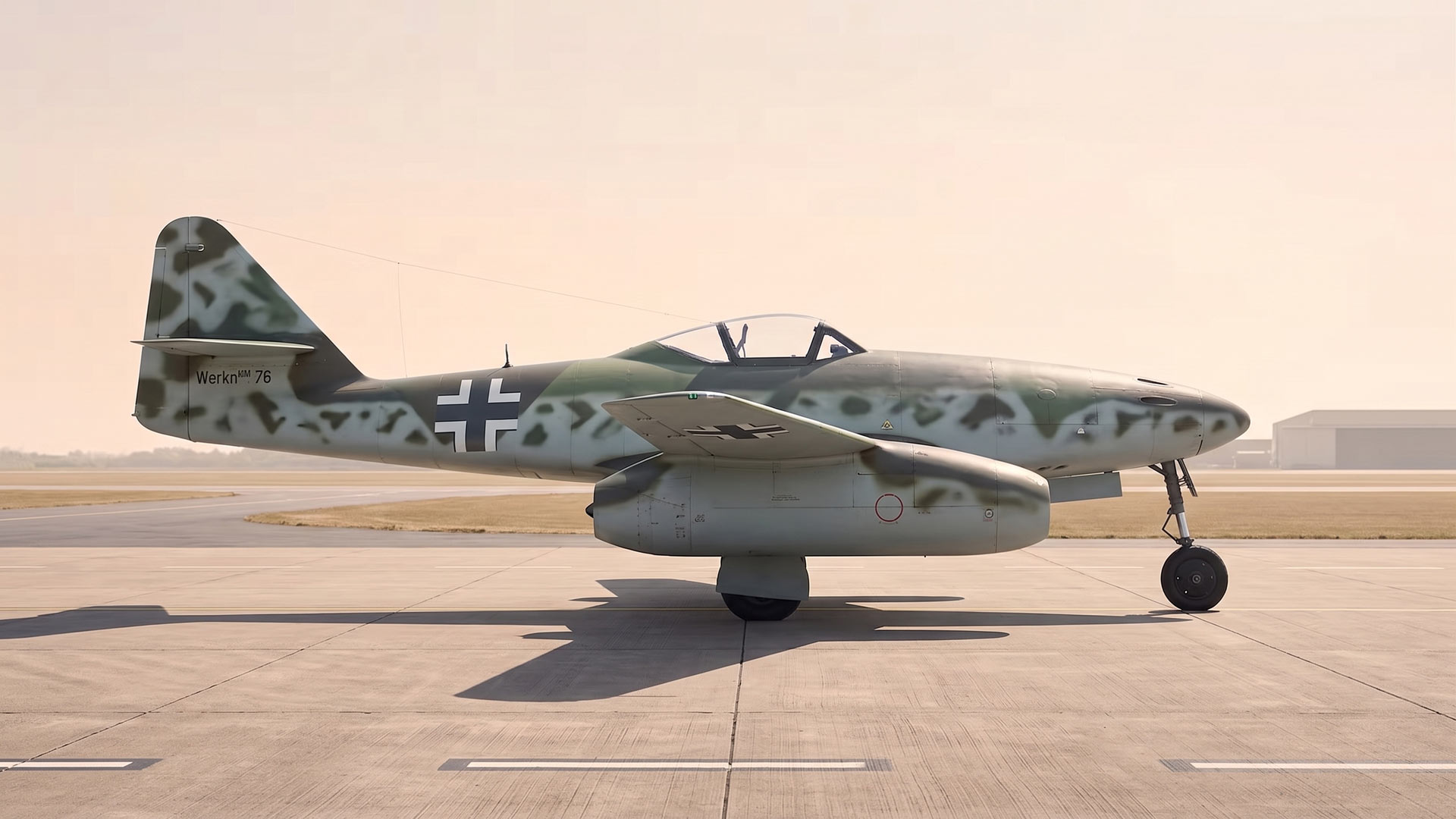
Messerschmitt Me 262 Schwalbe. A historic icon of military aviation. The world’s first operational jet fighter.
Germany
Origin
First operational jet fighter
Role
870 km/h
Top speed
11,450 m
Service ceiling
Me 262 Schwalbe Specifications
The Messerschmitt Me 262 Schwalbe was the world’s first operational jet-powered fighter aircraft, its introduction ushered military aviation into the new jet age. It was engineered by Germany during World War II, combining swept wings with twin turbojets to deliver unmatched speed and devastating interceptor firepower.
Performance
Top speed
540 mph (870 km/h)
Service ceiling
37,565 ft (11,450 m)
Combat radius
652 miles (1,050 km) maximum range/approx. 230 miles combat radius
Rate of climb
3,937 ft/min (20 m/s)
Airframe
Crew
1 (standard fighter variants) or 2 (night fighter/trainer variants)
Length
34 ft 9 in (10.60 m)
Wingspan
40 ft 11 in (12.48 m)
Empty weight
8,378 lb (3,800 kg)
Engine
2 × Junkers Jumo 004B-1 turbojets, providing 1,980 lbf (8.8 kN) thrust each
Service
First flight
18 April 1941 (piston prototype); 18 July 1942 (jet engine prototype)
Unit cost
Approximately 87,400 RM (Reichsmarks) during World War II production
Operators
Luftwaffe (World War II), Czechoslovak Air Force (post-war as Avia S-92)
What Weapons Does The Me 262 Schwalbe Carry?
The Me 262 was designed primarily as a heavy bomber interceptor, equipped with high-impact, short-range weaponry that could quickly dismantle enemy formations. Its standard heavy cannon nose setup was frequently supplemented by unguided air-to-air rockets and light bomb loads.
Weapon
Category
Loadout
Range
MK 108 Cannon
Category
Cannon
Loadout
4 × 30 mm cannons (100 rounds per gun inner, 80 rounds outer)
Range
600 m (656 yd) effective range
R4M Rocket
Category
Air-to-air rocket
Loadout
24 × 55 mm unguided rockets mounted on underwing wooden racks
Range
1,000 m (1,093 yd) maximum range
SC 250 / SD 500
Category
Precision bomb / Free-fall bomb
Loadout
Up to 2 × 250 kg (550 lb) or 1 × 500 kg (1,100 lb) bombs (A-2a Sturmvogel)
Range
Visual drop / short tactical radius
Category
Loadout
Range
Category
Loadout
Range
Category
Loadout
Range
Category
Loadout
Range
Category
Loadout
Range
Category
Loadout
Range
Category
Loadout
Range
Category
Loadout
Range
How Fast Is The Me 262 Schwalbe?
The Messerschmitt Me 262 was exceptionally fast for its era, achieving a top speed of 540 mph (870 km/h) at operational altitudes. Powered by twin Junkers Jumo 004 axial-flow turbojets, it was roughly 100 mph faster than the top Allied piston-engine fighters of World War II, such as the P-51 Mustang and Supermarine Spitfire. This speed advantage allowed the Me 262 to dictate the terms of engagement, intercept enemy bomber streams rapidly, and disengage at will, as Allied fighters simply could not catch it in level flight.
How Was The Me 262 Schwalbe Developed?
Development of the aircraft began in April 1939 under Project P.1065, led by Messerschmitt's chief designer, Woldemar Voigt, and overseen by Willy Messerschmitt. Initial airframe testing occurred in April 1941 using a nose-mounted piston engine due to delays in turbojet reliability. On 18 July 1942, the prototype made its first pure jet-powered flight, proving the viability of swept-wing aerodynamics and jet propulsion. However, mass production was severely delayed by technical difficulties with the Junkers Jumo 004 engines, strategic material shortages, heavy Allied bombing of German industrial infrastructure, and political interference that temporarily forced the aircraft to be redesigned as a fighter-bomber rather than a dedicated interceptor.
Has The Me 262 Schwalbe Seen Combat?
Yes, the Me 262 saw extensive operational combat during the final phases of World War II, primarily between mid-1944 and May 1945. Organised into specialised units such as Erprobungskommando 262, Jagdgeschwader 7, and the famous JV 44 led by Adolf Galland, Me 262 pilots targeted Allied heavy bomber formations over Europe. Despite accounting for over 500 claimed Allied aircraft destructions, the jet’s operational impact was constrained by acute fuel shortages, frequent engine maintenance demands, low numbers of combat-ready airframes, and aggressive Allied tactics that targeted the aircraft during its vulnerable take-off and landing phases.
Who Operates The Me 262 Schwalbe?
Historically, the Me 262 was operated primarily by the German Luftwaffe during World War II. Following the war, captured airframes were extensively evaluated by Allied nations, including the Royal Air Force, the United States Army Air Forces, and the Soviet Air Force, directly influencing post-war jet combat design. Czechoslovakia was the only nation to operate the type post-war, manufacturing and flying a small fleet of built-from-parts variants designated the Avia S-92 and CS-92 until 1951. Today, no original World War II Me 262 airframes remain in active operational military service; however, a limited number of modern, highly accurate flying replicas built by the Me 262 Project are owned and operated by heritage organisations and private collections, such as the Military Aviation Museum in the United States and the Messerschmitt Foundation in Germany.
Me 262 Schwalbe FAQs
Common questions about the Me 262 Schwalbe, its capabilities and whether civilians can fly it.
Can I fly in an Me 262 Schwalbe?
You cannot fly in an original Me 262 Schwalbe, but passenger flights are occasionally offered in replicas. Authentic World War II-era airframes are not available to the public due to their rarity, historical value and maintenance limits. Modern FAA-certified dual-seat replicas, such as Me 262 B-1c reproductions, are operated by heritage foundations and private organisations in the United States and Europe.
Can I take the controls of an Me 262 Schwalbe?
Only in limited cases: you cannot pilot an original or replica Me 262 Schwalbe without specialised multi-engine jet ratings, extensive high-performance jet hours and clearance from its operating organisation. On select VIP or specialised programmes in dual-control trainer variants, participants under a rated instructor’s supervision may be given temporary control at safe cruising altitudes.
How much does a flight in an Me 262 Schwalbe cost?
An Me 262 Schwalbe replica flight is not available through Jetify, and package prices for rare multi-engine vintage jets like it can significantly exceed standard military jet experiences, due to the high cost of maintaining custom jet turbines. Jetify flights in jets such as the L-39 Albatros start from around £2,500, $3,300 or €2,900.
Is there a weight or height limit to fly in an Me 262 Schwalbe?
Yes, the tight cockpit of the 1940s Me 262 Schwalbe design imposes strict limits. Passengers typically must weigh under 16 to 18 stone (100 to 115 kg) and be between 5 ft 2 in (157 cm) and 6 ft 2 in (188 cm) tall, for proper canopy clearance, correct centre-of-gravity balance and safe emergency entry and exit.
How much G-force will I feel in an Me 262 Schwalbe?
On an Me 262 Schwalbe demonstration or heritage passenger flight, G-forces typically range from +2.0G to +4.0G during banked turns and steep climbs. The airframe was built for higher structural loads, but flights in surviving or replica aircraft are carefully managed to avoid unnecessary airframe stress and keep passengers comfortable.
How far in advance should I book an Me 262 Schwalbe flight?
Book an Me 262 Schwalbe replica flight 6 to 12 months in advance through accredited aviation heritage organisations or flight experience operators. Flight-capable replicas are exceptionally rare, and availability is limited by rigorous maintenance schedules, weather windows and restricted annual flight hours.
Explore the database