What Is The Yak-130?
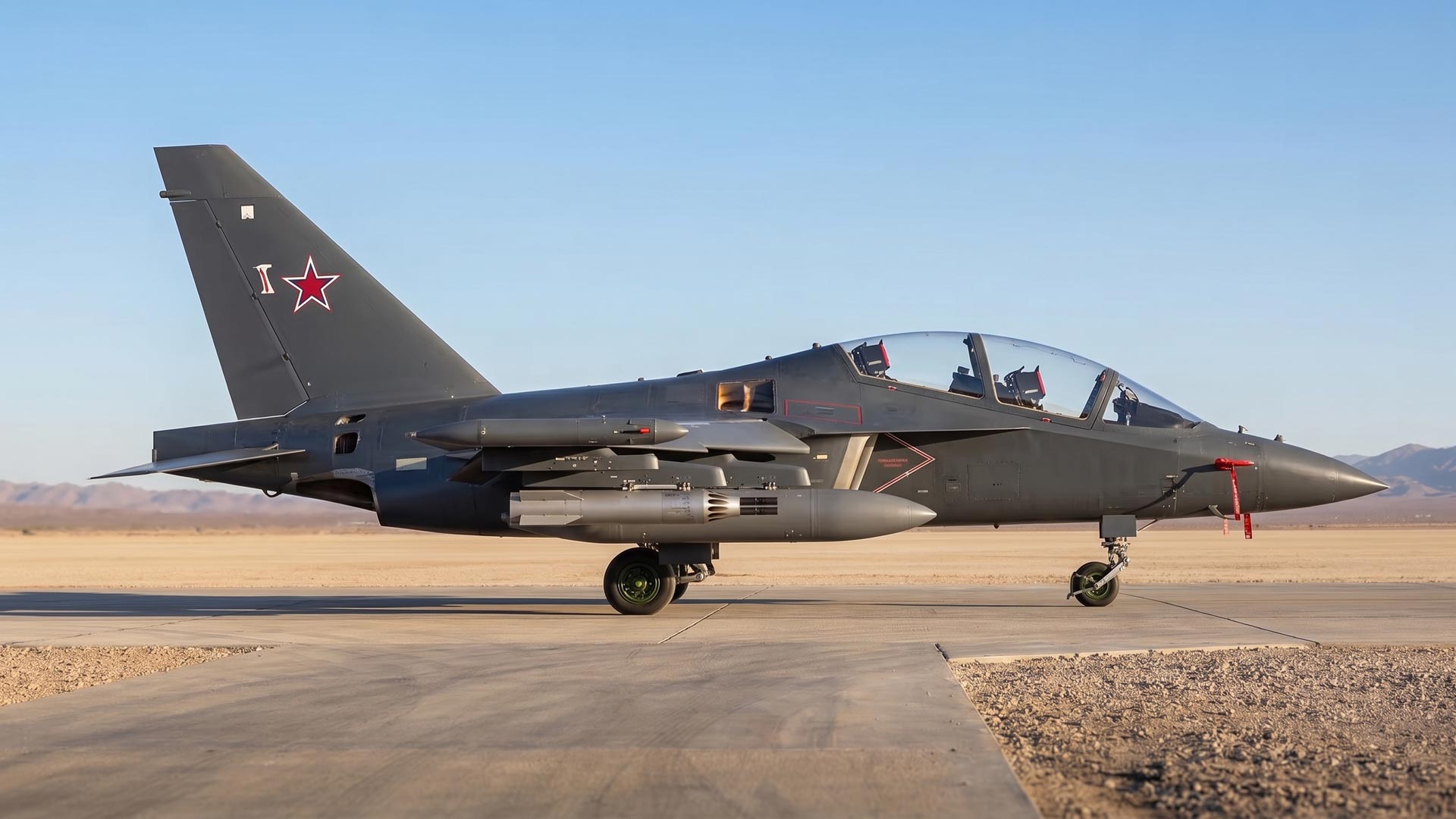
The Yakovlev Yak-130. An advanced Russian subsonic jet trainer and light attack aircraft offering 4th/5th-gen flight simulation.
Russia
Origin
Advanced trainer
Role
Mach 0.93
Top speed
12,500 m
Service ceiling
Yak-130 Specifications
The Yakovlev Yak-130 is an advanced jet trainer and light-attack platform featuring fly-by-wire controls capable of replicating the handling of modern 4th and 5th generation combat aircraft. It features a twin-engine and tandem-seat.
Performance
Top speed
1,060 km/h (659 mph/Mach 0.93)
Service ceiling
12,500 m (41,000 ft)
Combat radius
555 km (345 miles/300 nmi) on internal fuel
Rate of climb
65 m/s (12,800 ft/min)
Airframe
Crew
2 (Student and Instructor/Pilot and Weapons System Officer)
Length
11.49 m (37 ft 8 in)
Wingspan
9.84 m (32 ft 3 in)
Empty weight
4,600 kg (10,141 lb)
Engine
2 × Ivchenko-Progress AI-222-25 non-afterburning turbofans (24.5 kN/5,500 lbf thrust each)
Service
First flight
25 April 1996
Unit cost
Approximately $15 million – $18 million USD
Operators
Russia, Algeria, Belarus, Myanmar, Bangladesh, Vietnam, Laos, Iran, Ethiopia
What Weapons Does The Yak-130 Carry?
The Yak-130 features nine external hardpoints (eight wing-mounted, one centreline) supporting up to 3,000 kg of payload. It employs a reconfigurable digital combat suite to simulate or deploy air-to-air missiles, precision-guided munitions, unguided bombs, and gun pods.
Weapon
Category
Loadout
Range
R-73 (AA-11 Archer)
Category
Air-to-Air Missile
Loadout
Up to 2–4 missiles
Range
30 km – 40 km
Kh-25 (AS-10 Karen)
Category
Precision Guided Air-to-Surface Missile
Loadout
Up to 2 missiles
Range
11 km – 40 km
KAB-500Kr / KAB-500S-E
Category
Precision Guided Bomb
Loadout
Up to 2–4 bombs
Range
15 km – 25 km
FAB-500 / FAB-250
Category
General-Purpose Unguided Bomb
Loadout
Up to 4–6 bombs
Range
Gravity-drop
S-8 / S-13 Rockets
Category
Unguided Rocket Pods
Loadout
Up to 4 pods (B-8M / B-13L)
Range
2 km – 4.5 km
SNPU-130 Pod (GSh-23L)
Category
23 mm Twin-Barrel Cannon
Loadout
1 pod (Centerline or Wing)
Range
1.5 km – 2 km
Category
Loadout
Range
Category
Loadout
Range
Category
Loadout
Range
Category
Loadout
Range
Category
Loadout
Range
How Fast Is The Yak-130?
The Yakovlev Yak-130 is engineered specifically as a high-subsonic aircraft, reaching a maximum level speed of 1,060 km/h (659 mph/Mach 0.93) at high altitude. Unlike supersonic frontline interceptors, the jet intentionally lacks afterburners to prioritise fuel efficiency, extended flight endurance, and smooth handling characteristics across high angles of attack. Its twin Ivchenko-Progress AI-222-25 turbofans allow for an impressive rate of climb of 65 m/s (12,800 ft/min), allowing the jet to reach its operating ceiling of 41,000 feet rapidly. Cruising comfortably at 890 km/h (553 mph), the Yak-130 replicates the subsonic performance envelopes and dynamic high-G manoeuvring profiles of 4th and 5th-generation combat fighters, making it an ideal lead-in platform for modern pilot training.
How Was The Yak-130 Developed?
Development of the Yak-130 began in 1991 when the Soviet Union sought a modern trainer to replace the aging fleet of Aero L-39 Albatros aircraft. Following the collapse of the USSR, the Yakovlev Design Bureau partnered with Italian manufacturer Aermacchi in 1993 to co-develop the AEM/Yak-130 prototype. The joint project achieved its maiden flight on 25 April 1996. However, diverging design priorities led to a peaceful separation in 2000. Yakovlev retained basic technical documentation to produce the Yak-130 for Russia and export markets, while Aermacchi used the core blueprint to build the Alenia Aermacchi M-346 Master. The Yak-130 officially won the Russian Air Force trainer tender in 2002, entering full-scale production and formal military service in 2010 equipped with advanced digital fly-by-wire controls.
Has The Yak-130 Seen Combat?
Yes, the Yak-130 has seen active operational deployment in secondary light-attack, counter-insurgency, and air-defence roles. The Myanmar Air Force has deployed its Yak-130 fleet extensively in ground-attack missions, utilising unguided rockets and bombs against insurgent positions in regional conflicts. Additionally, operators in North Africa and Eastern Europe maintain the Yak-130 in dual-role defence roles capable of air-to-ground strikes. In modern air-combat engagements, military reports indicate Iranian-operated Yak-130s have participated in defensive airspace operations. While primarily engineered as an advanced trainer, its 3,000 kg weapons payload and modern targeting systems allow it to function effectively as a dedicated close-air-support (CAS) platform in low-threat environments.
Who Operates The Yak-130?
The Yak-130 is operated primarily by the Russian Aerospace Forces, which acts as its launch customer with over 100 units in service. Internationally, the aircraft has established a strong export footprint across Asia, Africa, and the Middle East due to its cost-effective multi-role capability. Key foreign operators include Algeria, Belarus, Myanmar, Bangladesh, Vietnam, Laos, Ethiopia, and Iran. These defence forces utilise the Yak-130 both as a lead-in fighter trainer (LIFT) to transition pilots onto modern fighter platforms such as the Su-30, Su-35, and MiG-29, and as an active light-strike aircraft for border patrol and tactical air support.
Yak-130 FAQs
Common questions about the Yak-130, its capabilities and whether civilians can fly it.
Can a civilian fly in the Yak-130?
Civilians generally cannot fly in the Yak-130, because it remains an active, modern military aircraft in frontline air force inventories. Rides are limited to authorised state defence programmes, military exchange events or specific flight experience providers operating under specialised military-civilian clearance in select international jurisdictions.
Can I take the controls of the Yak-130?
In official flight programmes, participants flying in a dual-control Yak-130 with a qualified instructor pilot may handle the controls in level flight and basic manoeuvres. Its advanced fly-by-wire system includes automated flight envelope protection, which prevents accidental over-stressing or stalling and makes hands-on control safe under instructor oversight.
How much does a flight in the Yak-130 cost?
Civilian flights in a modern Yak-130 are largely unavailable on the consumer market, so there is no standard price. Operating costs for the high-performance Yak-130 exceed $3,000 to $5,000 per flight hour. Jetify flights in comparable military trainers such as the L-39 Albatros start from around £2,500, $3,300 or €2,900.
Is there a weight or height limit to fly the Yak-130?
Yes, the Yak-130’s Zvezda K-36LT3.5 ejection seats impose strict limits on tandem cockpit occupants. They must typically be between 160 cm and 190 cm (5 ft 3 in to 6 ft 3 in) tall and weigh between 50 kg and 108 kg (110 lbs to 238 lbs), to ensure safe harness fit and ejection clearance.
How much G-force does the Yak-130 pull?
The Yak-130 is certified to pull between +8.0G and -3.0G in aerobatic operations. A standard introductory flight is tailored to your comfort, usually with moderate +2.0G to +4.0G turns, while high-performance aerobatic flights with steep climbs and tight loops can reach +6.0G or more and need proper anti-G breathing techniques.
How far in advance should I book a Yak-130 flight?
Book a Yak-130 or other specialised jet flight experience, or a military flight-demonstration package, 3 to 6 months in advance. This lead time allows for the required security screening, medical clearance assessments, airspace reservation approvals and coordination with accredited flight training facilities.
Explore the database