What Is The F-14 Tomcat?
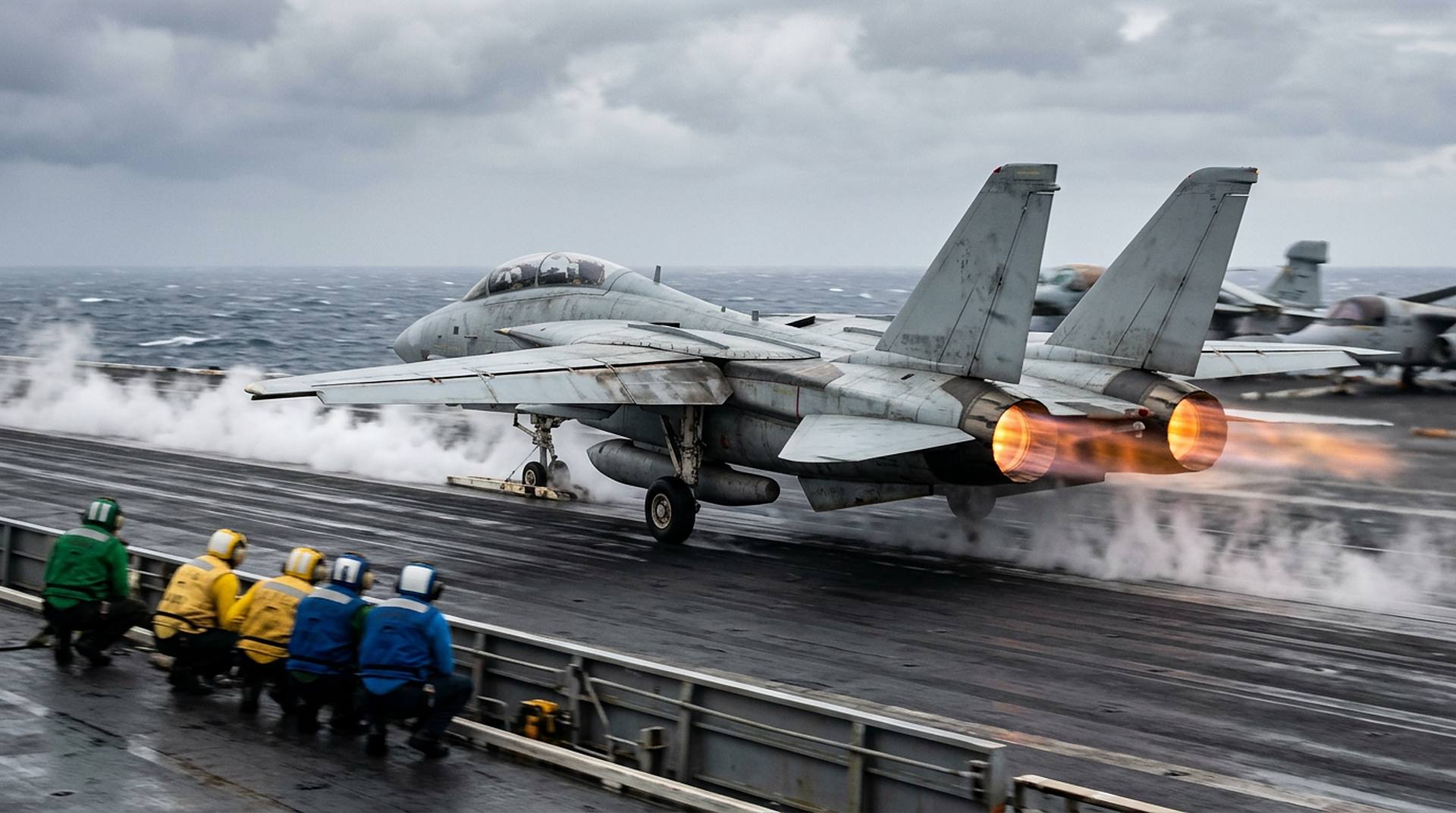
The Grumman F-14 Tomcat. The iconic twin-engine, variable-sweep wing maritime air superiority fighter jet.
United States
Origin
Carrier interceptor
Role
Mach 2.34
Top speed
15,200 m
Service ceiling
F-14 Tomcat Specifications
The Grumman F-14 Tomcat is a supersonic, twin-engine, two-seat, variable-sweep wing fighter, built specifically for carrier operations. Developed for the US Navy, it specialised in air superiority, fleet air defence, and tactical reconnaissance.
Performance
Top speed
Mach 2.34 (2,485 km/h) at high altitude
Service ceiling
50,000+ ft (15,200 m)
Combat radius
575 nautical miles (926 km)
Rate of climb
45,000 ft/min (229 m/s)
Airframe
Crew
2 (Pilot and Radar Intercept Officer)
Length
19.1 m (62 ft 9 in)
Wingspan
19.55 m (64 ft 1 in) unswept; 11.58 m (38 ft) swept
Empty weight
19,838 kg (43,735 lb)
Engine
2 × Pratt & Whitney TF30-P-412A (F-14A) or 2 × General Electric F110-GE-400 (F-14B/D) turbofans
Service
First flight
21 December 1970
Unit cost
Approximately $38 million USD (F-14D variant)
Operators
United States Navy (retired 2006), Islamic Republic of Iran Air Force
What Weapons Does The F-14 Tomcat Carry?
The F-14 Tomcat was engineered around the long-range AN/AWG-9 radar and the AIM-54 Phoenix missile system, allowing it to track up to 24 targets and engage 6 simultaneously. It was later adapted into the “Bombcat” to carry precision-guided ground munitions.
Weapon
Category
Loadout
Range
M61A1 Vulcan
Category
20 mm Gatling Cannon
Loadout
1 internal cannon (675 rounds)
Range
1.5 km
AIM-54 Phoenix
Category
Long-Range Air-to-Air Missile
Loadout
Up to 6 missiles
Range
190 km (100+ nmi)
AIM-7 Sparrow
Category
Medium-Range Air-to-Air Missile
Loadout
Up to 6 missiles
Range
70 km
AIM-9 Sidewinder
Category
Short-Range Air-to-Air Missile
Loadout
Up to 4 missiles
Range
18 km
GBU-12 / GBU-16 Paveway II
Category
Laser-Guided Precision Bomb
Loadout
Up to 4 bombs
Range
15 km
GBU-31 / GBU-38 JDAM
Category
GPS-Guided Precision Bomb
Loadout
Up to 4 bombs
Range
24 km
Mark 80 Series (Mk 82/83/84)
Category
General-Purpose Unguided Bombs
Loadout
Up to 14 bombs
Range
Ballistic drop
Category
Loadout
Range
Category
Loadout
Range
Category
Loadout
Range
Category
Loadout
Range
How Fast Is The F-14 Tomcat?
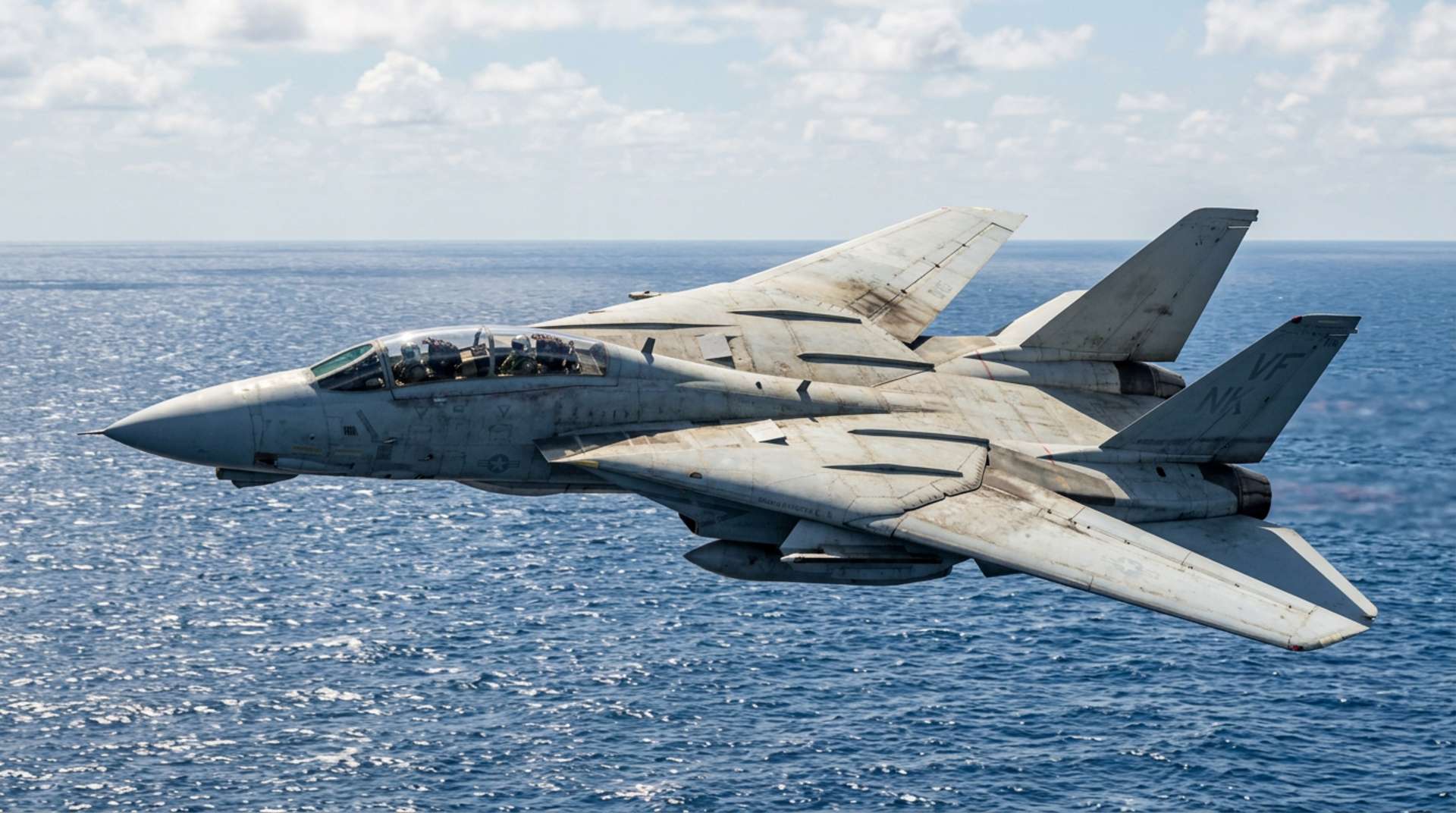
The Grumman F-14 Tomcat is exceptionally fast, capable of achieving a maximum top speed of Mach 2.34 (approximately 1,544 mph or 2,485 km/h) at high altitudes. Remarkable velocity is achieved by twin afterburning turbofan engines combined with variable-geometry wings that automatically adjust their sweep angle between 20 degrees and 68 degrees in flight. This automated sweep optimises aerodynamic drag, allowing the aircraft to maintain stability at low landing speeds while reaching extreme supersonic speeds to intercept airborne threats rapidly.
How Was The F-14 Tomcat Developed?
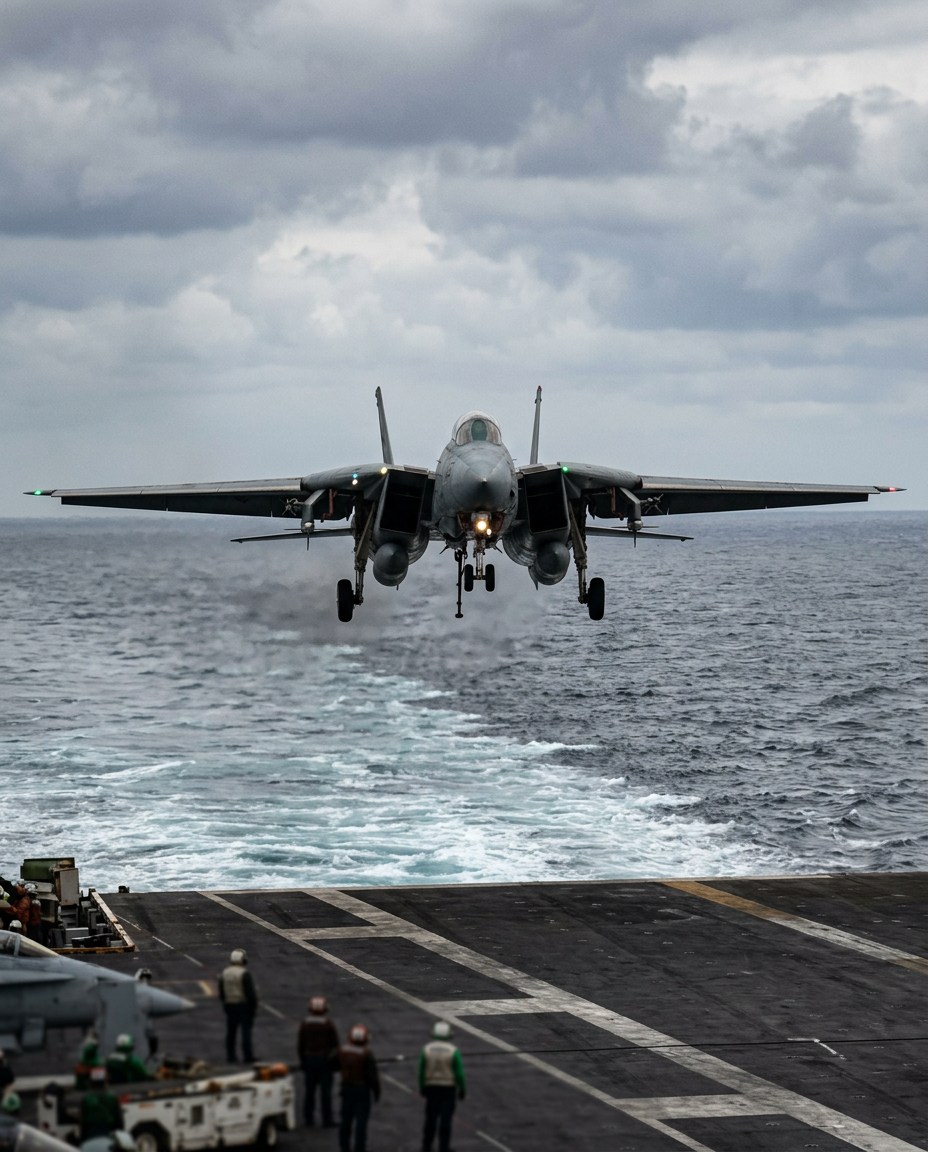
The development of the F-14 Tomcat originated in the late 1960s when the United States Navy sought a replacement for the failed General Dynamics F-111B programme. The Navy required a dedicated carrier-based fleet defence fighter capable of defending carrier battle groups against high-speed Soviet anti-ship missiles and bombers. Grumman won the VFX design contract in 1969, incorporating the advanced Hughes AN/AWG-9 radar and heavy AIM-54 Phoenix missile system originally intended for the F-111B. Designed with twin tails, variable-sweep wings, and wide engine tunnels for extra lift, the F-14 made its maiden flight on 21st December 1970 and formally entered service in 1974.
Has The F-14 Tomcat Seen Combat?
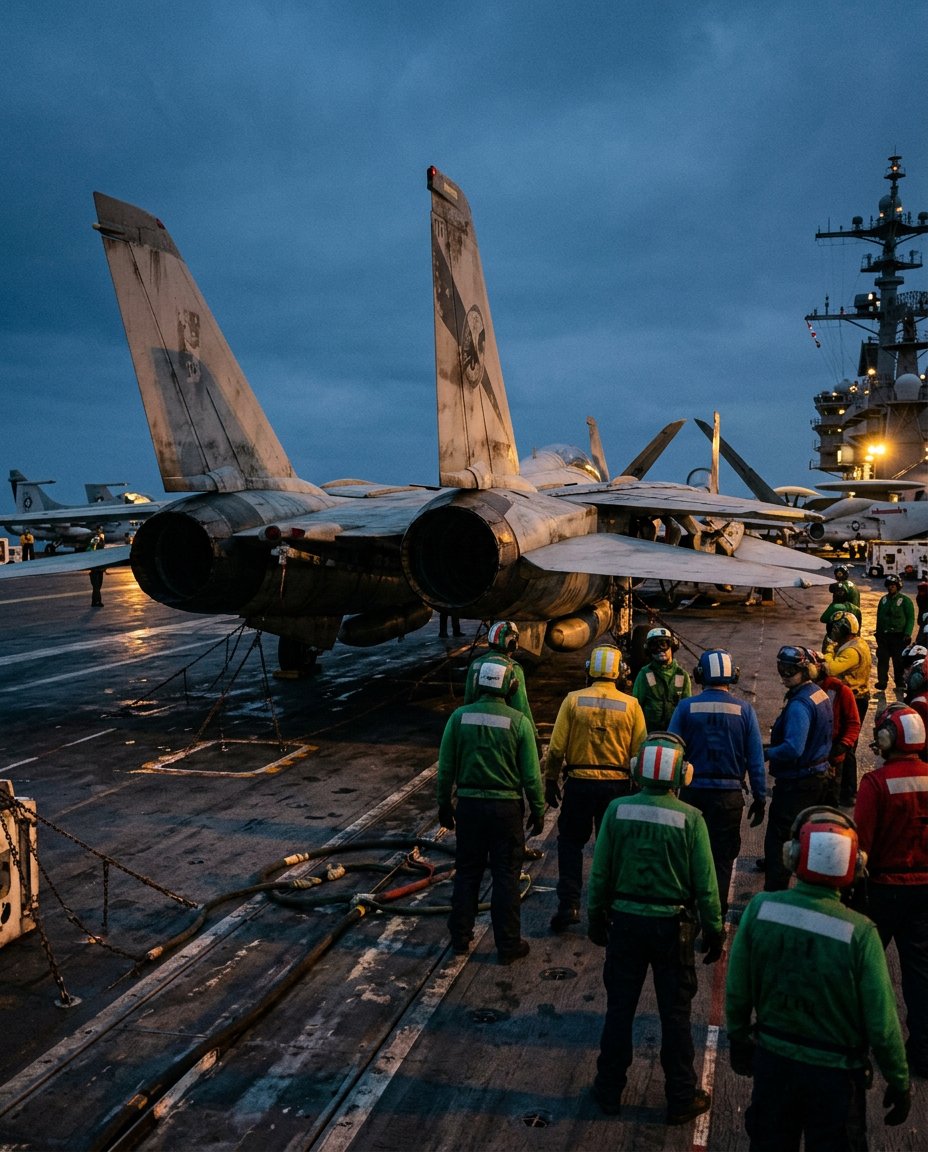
Yes, the F-14 Tomcat has an extensive operational combat history spanning over three decades. US Navy Tomcats first saw operational combat over the Gulf of Sidra in 1981, downing two Libyan Su-22 jets, followed by additional dogfight victories over Libyan MiG-23s in 1989. The F-14 played vital fleet defence, escort, and reconnaissance roles during Operation Desert Storm in 1991, and later transitioned into a precision strike bomber role ("Bombcat") during operations in Bosnia, Kosovo, Afghanistan (Operation Enduring Freedom), and Iraq (Operation Iraqi Freedom). Outside the US, the Islamic Republic of Iran Air Force deployed F-14s extensively during the Iran–Iraq War (1980–1988), achieving over 100 confirmed aerial victories against Iraqi aircraft.
Who Operates The F-14 Tomcat?
Historically, the primary operator of the F-14 Tomcat was the United States Navy, which flew the aircraft from 1974 until its official retirement in September 2006. The only foreign nation ever authorised to purchase the F-14 was Imperial Iran, which ordered 80 aircraft prior to the 1979 Iranian Revolution. Today, the United States Navy no longer operates the jet, having replaced its fleet with the Boeing F/A-18E/F Super Hornet. As of 2026, the Islamic Republic of Iran Air Force remains the sole operator of the F-14 Tomcat, maintaining a active fleet of domestically overhauled F-14A and upgraded F-14AM variants.
F-14 Tomcat FAQs
Common questions about the F-14 Tomcat, its capabilities and whether civilians can fly it.
Can a civilian fly in the F-14 Tomcat?
No, civilians cannot fly in the F-14 Tomcat as pilot or passenger, because no civilian-registered or flyable F-14s operate anywhere in the world. In US Navy service, the Tomcat needed a two-person crew: a qualified naval aviator in the front cockpit and a Radar Intercept Officer (RIO) in the rear seat operating the AN/AWG-9 weapons system.
Can I take the controls of the F-14 Tomcat?
No, civilians cannot take the controls of the F-14 Tomcat today, because no airworthy Tomcat exists in public or private hands. Even in service, the RIO in the back seat could not control the flight path, as the F-14’s rear cockpit was designed without flight controls such as a stick or rudder pedals.
How much does a flight in the F-14 Tomcat cost?
You cannot buy a flight in the F-14 Tomcat at any price, because the US Department of Defense scrapped and shredded retired airframes to keep spare parts from foreign operators. The Tomcat cost the US military upwards of $30,000 to $40,000 per flight hour, due to intensive maintenance and its complex variable-sweep wings. Jetify flights in jets such as the L-39 Albatros start from around £2,500, $3,300 or €2,900.
Was there a weight or height limit for F-14 Tomcat crews?
Yes, F-14 Tomcat crews were bound by strict US Navy limits for the Martin-Baker GRU-7A ejection seat. Crew members generally had to stand between 5 ft 4 in (162 cm) and 6 ft 4 in (193 cm) tall and weigh under 210 lbs (95 kg), for safe clearance during canopy ejection and correct centre-of-gravity balance.
How much G-force did the F-14 Tomcat pull?
F-14 Tomcat aircrews routinely pulled between +6.5g and +7.5g in operational combat and training sorties, the airframe’s structural design limit under heavy loads. In high-speed dogfighting or hard break turns, crews felt forces up to seven times their body weight, which required specialised anti-G suits and breathing techniques.
How far in advance can I book an F-14 Tomcat flight?
You cannot book an F-14 Tomcat flight with any aviation provider in the world. For a real military jet experience, look at dual-seat aircraft available through private operators instead, such as the demilitarised L-39 Albatros or other jet trainers, which typically need booking 3 to 6 months in advance.
Explore the database