What Is The Su-27 Flanker?
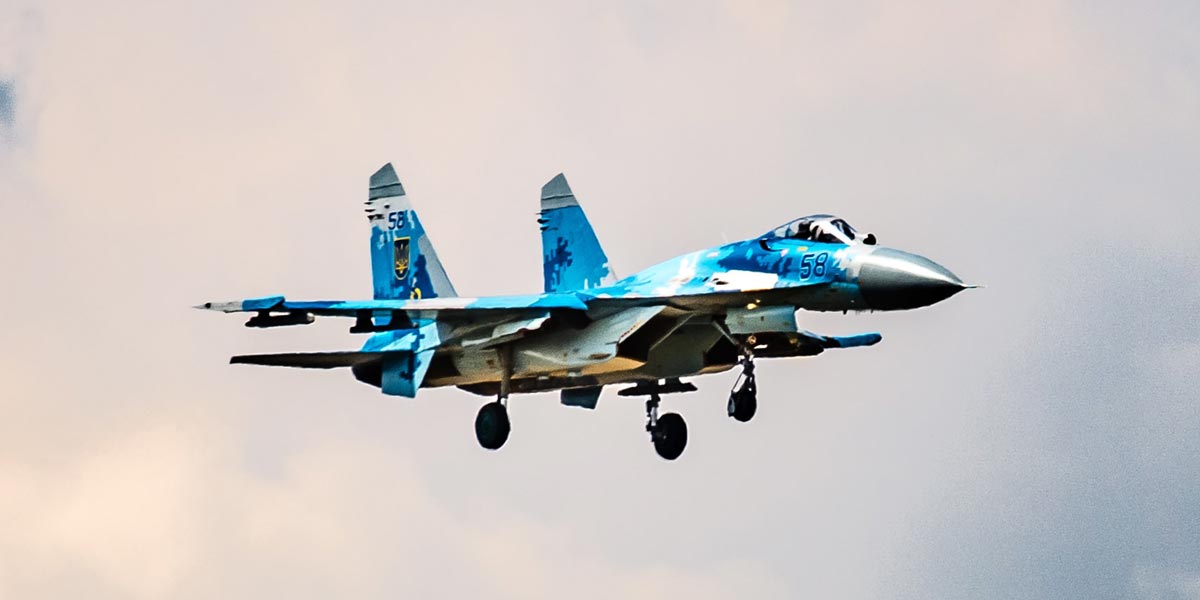
The Sukhoi Su-27 Flanker. A legendary Soviet air superiority fighter renowned for extreme agility and Mach 2.35 speed.
Russia
Origin
Air superiority
Role
Mach 2.35
Top speed
18,500 m
Service ceiling
Su-27 Flanker Specifications
The Sukhoi Su-27 Flanker is a heavy, long-range air superiority fighter developed by the Soviet Union. Renowned for its extraordinary agility, high speed, and blended wing-body design, it was built to dominate the skies against fourth-generation Western jet fighters.
Performance
Top speed
2,500 km/h (Mach 2.35) at altitude
Service ceiling
18,500 m (60,700 ft)
Combat radius
Approximately 1,340 km (830 miles)
Rate of climb
300 m/s (59,000 ft/min)
Airframe
Crew
1 (standard single-seat fighter) or 2 (Su-27UB variant)
Length
21.94 m (72 ft 0 in)
Wingspan
14.70 m (48 ft 3 in)
Empty weight
16,380 kg (36,110 lb)
Engine
2 × Saturn/Lyulka AL-31F afterburning turbofans
Service
First flight
20 May 1977
Unit cost
Approximately $30 million USD (standard production variant)
Operators
Russia, Ukraine, China (as J-11), Kazakhstan, Uzbekistan, Angola, Vietnam, Ethiopia, Indonesia, and others
What Weapons Does The Su-27 Flanker Carry?
The Su-27 Flanker features 10 external hardpoints capable of mounting up to 4,430 kg of ordnance. Designed primarily for beyond-visual-range (BVR) and close-in air defence, its versatile weapons suite combines precision air-to-air missiles, unguided strike munitions, and an integrated high-rate-of-fire internal autocannon.
Weapon
Category
Loadout
Range
GSh-30-1
Category
30mm Internal Autocannon
Loadout
1 internal mount (150 rounds)
Range
1.2 km - 1.8 km
R-27R / R-27ER (AA-10 Alamo)
Category
Medium-Range Semi-Active Radar Air-to-Air Missile
Loadout
Up to 6 missiles
Range
80 km - 130 km
R-27T / R-27ET (AA-10 Alamo)
Category
Medium-Range Infrared Air-to-Air Missile
Loadout
Up to 2 missiles
Range
70 km - 120 km
R-73 (AA-11 Archer)
Category
Short-Range Infrared Air-to-Air Missile
Loadout
Up to 6 missiles
Range
30 km - 40 km
R-77 (AA-12 Adder)
Category
Active Radar Air-to-Air Missile (Modernised Variants)
Loadout
Up to 6 missiles
Range
110 km
FAB-500 / FAB-250
Category
General-Purpose Unguided Aerial Bomb
Loadout
Up to 8 bombs
Range
Gravity-dropped (visual range)
S-8 Rocket Pods
Category
80mm Unguided Aircraft Rocket System
Loadout
Up to 4 pods (80 rockets total)
Range
2 km - 4 km
S-13 Rocket Pods
Category
122mm Heavy Unguided Rocket System
Loadout
Up to 4 pods (20 rockets total)
Range
3 km - 4 km
Category
Loadout
Range
Category
Loadout
Range
Category
Loadout
Range
How Fast Is The Su-27 Flanker?
The Su-27 Flanker achieves a staggering top speed of Mach 2.35 (approximately 2,500 km/h or 1,550 mph) at high altitudes, powered by twin Lyulka/Saturn AL-31F afterburning turbofans generating over 27,000 lbs of thrust per engine. At sea level, it maintains a clean-configuration dash speed of Mach 1.13 (1,400 km/h). This remarkable speed is paired with an impressive climb rate of 300 metres per second (59,000 feet per minute). Beyond simply speed, the Flanker’s blended wing-body design and fly-by-wire controls provide low-speed agility, enabling dynamic manoeuvres such as "Pugachev's Cobra," where the aircraft briefly pitches up past vertical to a 120-degree angle of attack without stalling or losing control.
How Was The Su-27 Flanker Developed?
Development of the Su-27 began in the late 1960s under the Soviet Union's PFI (Perspektivny Frontovoy Istrebitel - Prospective Frontline Fighter) programme. The Soviet Air Force sought an advanced long-range air superiority fighter specifically designed to outclass the United States Air Force's emerging F-15 Eagle. Led by chief designer Mikhail Simonov at the Sukhoi Design Bureau, the initial prototype, designated T-10-1, took its maiden flight on 20 May 1977. However, test flights revealed major design deficiencies in stability and wing structure. Demonstrating remarkable engineering discipline, Simonov completely redesigned the airframe – incorporating relaxed stability, leading-edge root extensions (LERX), and full fly-by-wire flight control systems – resulting in the T-10S design. This redesigned iteration entered full operational service with the Soviet Air Forces in 1985 as the Su-27 Flanker-B, subsequently spawning an extensive family of fighters including the Su-30, carrier-capable Su-33, Su-34 strike aircraft, and advanced Su-35.
Has The Su-27 Flanker Seen Combat?
The Su-27 Flanker has seen extensive combat across multiple global conflicts since the early 1990s. Its first major operational deployments occurred during internal post-Soviet border disputes, including air defence sorties over Abkhazia in 1992–1993. The aircraft gained international attention during the 1998–2000 Eritrean-Ethiopian War, where Ethiopian Su-27s engaged Eritrean MiG-29s in intense dogfights, successfully shooting down several MiG-29s without sustaining losses. Russian Su-27s participated in combat operations during the 2008 Russo-Georgian War, executing air dominance missions over the Caucasus region. Crucially, the Su-27 family plays a major role in contemporary warfare; both the Russian Aerospace Forces (VKS) and the Ukrainian Air Force actively fly Su-27 platforms for combat air patrols, strike escort, and defence Suppression (SEAD) operations, marking it as one of the most battle-tested air superiority platforms in modern aviation history.
Who Operates The Su-27 Flanker?
The primary active operator of the original Su-27 Flanker series is the Russian Aerospace Forces (VKS), maintaining large fleets of modernised Su-27S, Su-27SM, and dual-seat Su-27UB variants alongside newer derivatives like the Su-30 and Su-35. The Ukrainian Air Force also operates an upgraded fleet of Su-27P1M and Su-27S1M fighters. Nationally exported variants (Su-27SK and Su-27UBK) are maintained in active service by international air forces, including the People's Liberation Army Air Force (PLAAF) of China (which also produced licensed domestic variants known as the Shenyang J-11), the Vietnamese People's Air Force, the Kazakh Air Defence Forces, the Uzbek Air and Air Defence Forces, the Angolan Air Force, the Ethiopian Air Force, the Indonesian Air Force, and the Eritrean Air Force. Former operators include the Belarusian Air Force, which retired its operational Su-27 fleet in 2012.
Su-27 Flanker FAQs
Common questions about the Su-27 Flanker, its capabilities and whether civilians can fly it.
Can a civilian fly in the Su-27 Flanker?
No civilian, whether a pilot or not, can currently fly a real Su-27 Flanker. As an active heavy frontline air superiority fighter, it is restricted to military pilots in air forces such as Russia, Ukraine and Kazakhstan. Non-pilots can, however, fly the Su-27 in high-fidelity full-motion flight simulators without prior flight experience or aviation licences.
Can I take the controls of the Su-27 Flanker?
No, taking the stick of an operational Su-27 Flanker is reserved for qualified military combat aviators. Civilian flights in dual-seat variants such as the Su-27UB were offered at select Russian airbases in the late 1990s and 2000s, but these programmes have been completely discontinued.
How much does a flight in the Su-27 Flanker cost?
Real Su-27 Flanker flights are not available on the commercial experience market at any price. Operating the heavy twin-engine jet costs over £20,000 per flight hour in fuel, engine maintenance and specialised ground crew support. Professional Su-27 simulator sessions cost a small fraction of a jet flight, and Jetify flights in jets such as the L-39 Albatros start from around £2,500, $3,300 or €2,900.
Is there a weight or height limit to fly the Su-27 Flanker?
Yes, the Zvezda K-36DM ejection seat in the Su-27 Flanker sets strict physical limits. Pilots generally must weigh between 50 kg (110 lbs) and 105 kg (231 lbs) and stand under 190 cm (6 ft 3 in) to ensure safe canopy clearance during an emergency ejection sequence.
How much G-force does the Su-27 Flanker pull?
The Su-27 Flanker is engineered to withstand operational loads from -3.0G to +9.0G. In extreme airshow demonstrations and high-alpha manoeuvres such as Pugachev’s Cobra, pilots face rapid G-onset rates that require specialised G-suits and rigorous physical conditioning to prevent G-induced loss of consciousness (G-LOC).
How far in advance should I book to see the Su-27 Flanker?
Book Su-27 Flanker simulator sessions, or tickets for international airshows featuring static or flying displays of the Su-27 family such as China’s Zhuhai Airshow, 2 to 4 months in advance, because demand is high and event capacity is restricted. Real Su-27 flights cannot be booked by civilians.
Explore the database