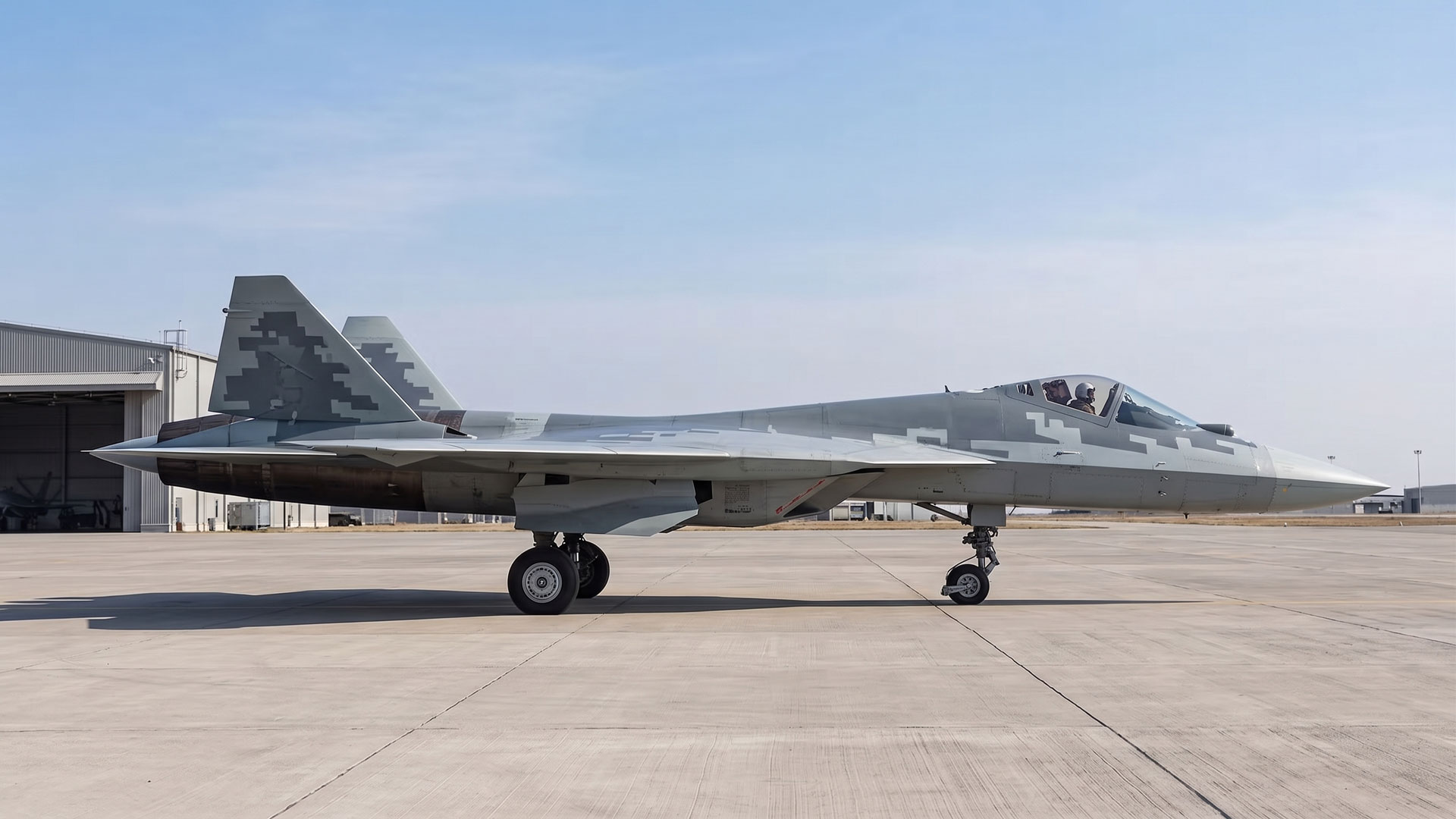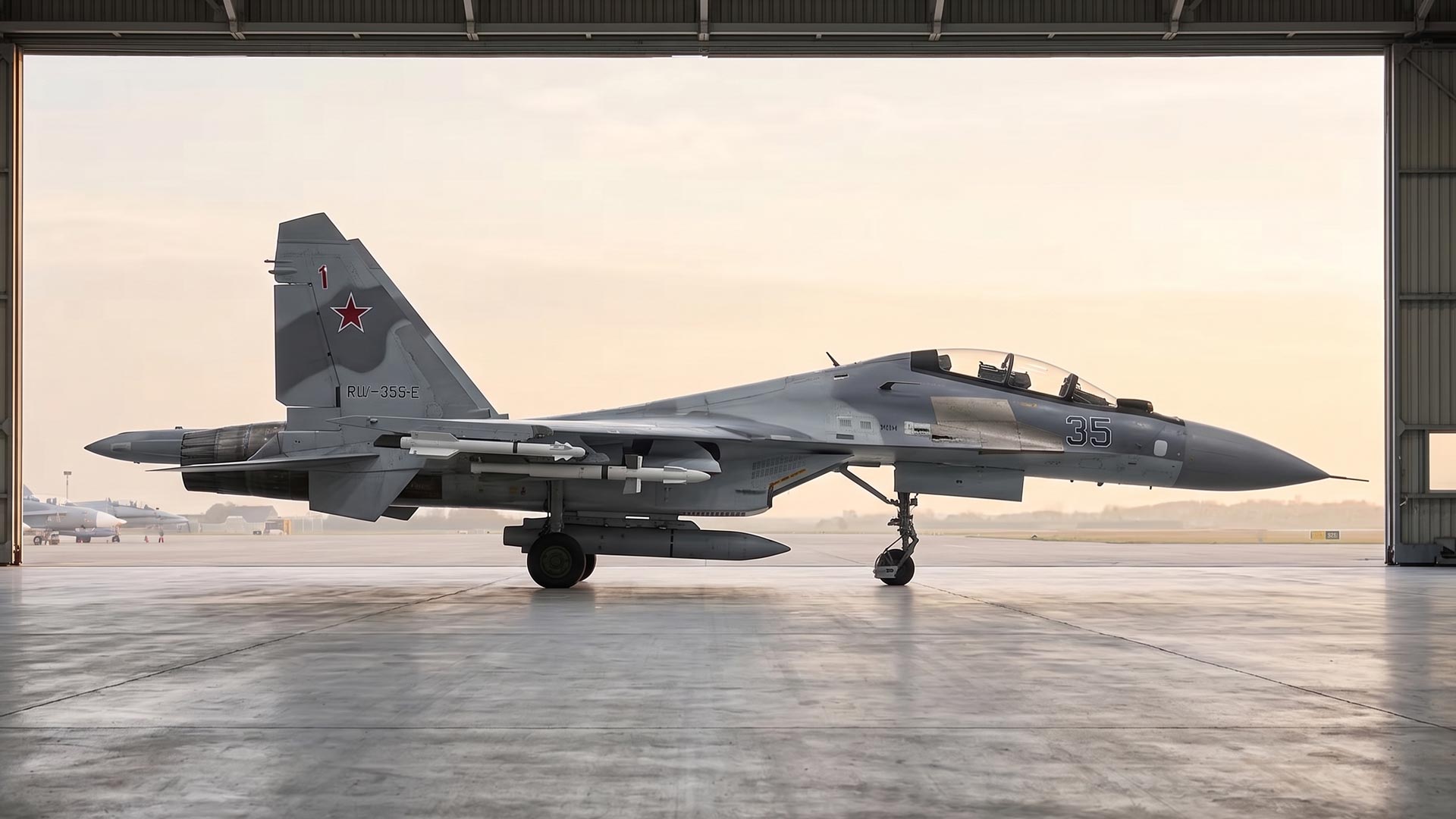
What Is The Su-35 Flanker-E?
The Sukhoi Su-35 Flanker-E. A heavy 4.5-generation Russian air-superiority jet boasting thrust-vectoring extreme agility.
Russia
Origin
Multirole
Role
Mach 2.25
Top speed
18,000 m
Service ceiling
Su-35 Flanker-E Specifications
The Sukhoi Su-35 Flanker-E is a 4.5-generation multirole fighter aircraft developed by the Sukhoi Design Bureau. With a single-seat and twin-engine its known for its exceptional thrust-vectoring manoeuvrability, advanced Irbis-E passive electronically scanned array (PESA) radar, and heavy payload capacity. A great representation of the absolute apex of the cold-war Flanker family design branch.
Performance
Top speed
2,400 km/h (1,490 mph/Mach 2.25) at altitude
Service ceiling
18,000 m (59,055 ft)
Combat radius
1,600 km (860 nautical miles/990 miles) internal fuel
Rate of climb
280 m/s (55,100 ft/min)
Airframe
Crew
1
Length
21.9 m (71.9 ft)
Wingspan
15.3 m (50.2 ft)
Empty weight
19,000 kg (41,888 lb)
Engine
2 × Saturn AL-41F1S afterburning turbofans with 3D thrust-vectoring nozzles
Service
First flight
19 February 2008 (Production Su-35S platform)
Unit cost
Approx. £65 million to £75 million ($83 million USD)
Operators
Russian Aerospace Forces, People’s Liberation Army Air Force (China), Islamic Republic of Iran Air Force
What Weapons Does The Su-35 Flanker-E Carry?
The Su-35 carries up to 8,000 kg of offensive ordnance distributed across 12 external hardpoints. It features an internal 30 mm autocannon and relies on a wide array of radar-guided and heat-seeking air-to-air missiles, precision air-to-surface missiles, anti-radiation platforms, and guided bombs.
Weapon
Category
Loadout
Range
GSh-30-1
Category
Internal Autocannon
Loadout
1 × 30 mm cannon (150 rounds)
Range
1.2 km – 1.8 km
R-73E / R-74
Category
Air-to-air (Short Range)
Loadout
Up to 6 missiles
Range
30 km – 40 km
R-77-1 (RVV-AE)
Category
Air-to-air (Medium Range)
Loadout
Up to 12 missiles
Range
110 km
R-27R/ER/T/ET
Category
Air-to-air (Semi-Active/Infrared)
Loadout
Up to 8 missiles
Range
80 km – 130 km
R-37M (RVV-BD)
Category
Air-to-air (Long Range)
Loadout
Up to 4 missiles
Range
200 km – 300+ km
Kh-31A/P
Category
Anti-ship / Anti-radiation
Loadout
Up to 6 missiles
Range
110 km – 220 km
Kh-29L/T
Category
Air-to-surface (Tactical)
Loadout
Up to 6 missiles
Range
10 km – 30 km
Kh-59MK
Category
Air-to-surface (Stand-off)
Loadout
Up to 5 missiles
Range
280 km
KAB-500KR/L
Category
Precision-guided Bomb
Loadout
Up to 8 bombs
Range
System dependent (Glide range)
KAB-1500KR/L
Category
Precision-guided Bomb
Loadout
Up to 3 bombs
Range
System dependent (Glide range)
FAB-500 M-62
Category
Unguided Bomb / UMPK Glide Kit
Loadout
Up to 10 bombs
Range
50 km – 70 km (with UMPK kit)
How Fast Is The Su-35 Flanker-E?
The Sukhoi Su-35 Flanker-E is capable of reaching a maximum speed of Mach 2.25 (approximately 2,400 km/h or 1,490 mph) at high altitudes. At sea level, the jet maintains a low-altitude speed of roughly 1,400 km/h (Mach 1.13), which allows it to close distances rapidly during interception profiles. Its raw speed is in thanks to the twin Saturn AL-41F1S afterburning turbofan engines. These deliver a combined thrust of up to 284 kN (63,800 lbf) in full reheat. Crucially, the aircraft blends high acceleration with super-manoeuvrability. While it is engineered for high supersonic dash speeds, its thrust-vectoring control nozzles allow it to transition from high-speed intercepts to post-stall manoeuvres, maintaining low and high velocity flight envelopes.
How Was The Su-35 Flanker-E Developed?
The development of the Su-35 began in the late 1980s as an ambitious deep-modernisation programme for the original Cold War Su-27 Flanker. Initially designated as the Su-27M, the early prototypes integrated canard foreplanes, updated radar systems, and digital fly-by-wire controls. However, the collapse of the Soviet Union delayed the project significantly, leading Sukhoi to redefine the aircraft in the mid-2000s under the internal project name T-10BM (Bolshaya Modernizatsiya – Big Modernisation). The designers stripped away the drag-inducing canard foreplanes and completely overhauled the airframe, incorporating light radar-absorbent materials, reinforced structural elements to extend airframe life, modern glass-cockpit avionics, and powerful Saturn AL-41F1S engines featuring 3D thrust-vectoring nozzles. This modernised iteration made its inaugural flight on 19 February 2008 and was formally designated by the Russian military as the Su-35S, fulfilling the role of an advanced interim "4.5-generation" jet designed to bridge the gap before fifth-generation stealth fighters entered operational service.
Has The Su-35 Flanker-E Seen Combat?
The Sukhoi Su-35 has seen extensive combat deployment in high-intensity modern battlefields. The type made its operational combat debut in early 2016 during the Russian military intervention in the Syrian Civil War, where it was deployed primarily to provide combat air patrols, cover bomber formations, and perform air-to-ground precision strike roles. Subsequently, the Su-35 became a core frontline air-superiority fighter in the full-scale invasion of Ukraine. In Ukrainian airspace, Su-35 squadrons have flown defensive counter-air missions, long-range engagements using R-77-1 and R-37M radar-guided missiles, electronic warfare escort, and suppressive attacks using SEAD anti-radiation weapons. During these combat operations, several aircraft have been downed by surface-to-air missile networks and air-to-air engagements, providing defence analysts with real-world data regarding the jet's operational performance, radar cross-section vulnerability, and combat resilience against modern air defence networks.
Who Operates The Su-35 Flanker-E?
The primary and largest operator of the Su-35 is the Russian Aerospace Forces (VKS), which has inducted well over 100 serial-production Su-35S aircraft into service across multiple fighter aviation regiments. On the export market, the People's Liberation Army Air Force (PLAAF) of China became the launch international customer, securing a deal for 24 Su-35SK variants delivered between 2016 and 2018. Iran has also emerged as a prominent operator, receiving Su-35 aircraft originally manufactured under an aborted contract for another nation. Further proposed international sales to nations such as Egypt, Indonesia, and Algeria faced major disruptions, delays, or cancellations due to global geopolitical sanctions under the US CAATSA framework and performance evaluations during wartime deployments, leaving China, Iran, and Russia as the main active operators of the type.
Su-35 Flanker-E FAQs
Common questions about the Su-35 Flanker-E, its capabilities and whether civilians can fly it.
Can a civilian fly in the Su-35 Flanker-E?
No, public civilian flights are not offered in the Su-35 Flanker-E, because it is an active frontline single-seat air superiority fighter used almost exclusively by state militaries. Civilian fighter jet experiences use specialised two-seat trainers such as the L-39 Albatros, or legacy twin-seat jet platforms, instead.
Can I take the controls of the Su-35 Flanker-E?
No, a civilian cannot take the controls of the Su-35 Flanker-E. The operational Su-35S is a single-seat aircraft flown by military pilots with years of advanced tactical jet training, and its complex fly-by-wire and thrust-vectoring controls require specialised combat aviation certification.
How much does a flight in the Su-35 Flanker-E cost?
You cannot buy a flight in the Su-35 Flanker-E, because civilians cannot fly it. Defence analysts estimate it costs £15,000 to £25,000 per flight hour to operate, covering fuel for its twin AL-41F1S afterburning turbofans, intensive ground-crew maintenance and specialised life-support systems. Jetify flights in jets such as the L-39 Albatros start from around £2,500, $3,300 or €2,900.
Is there a weight or height limit to fly in the Su-35 Flanker-E?
The Su-35 Flanker-E is not open to civilians, but strict height and weight limits apply to all high-performance fighter jet flights. Passengers typically must weigh under 108 kg (17 stone/240 lbs) and stand between 152 cm (5 ft 0 in) and 193 cm (6 ft 4 in). On the Su-35’s Zvezda K-36D-5 ejection seat, exceeding these limits can prevent a safe ejection or cause severe leg and spinal injuries.
How much G-force does the Su-35 Flanker-E pull?
Su-35 Flanker-E pilots experience up to +9G in maximum-performance combat manoeuvres and sustained high-speed turns, or nine times their body weight. This restricts blood flow to the brain, so pilots use anti-G suits and specialised breathing techniques (AGSM). Its 3D thrust-vectoring engines also cause rapid negative G and disorienting rotation in post-stall manoeuvres such as Pugachev’s Cobra and the Herbst manoeuvre.
How far ahead should I book a jet flight instead of the Su-35 Flanker-E?
Su-35 Flanker-E flights are not open for public booking, because state air force tasking controls its flight schedule. For civilian jet experiences or passenger flights in vintage military jets, book at least 3 to 6 months in advance, as limited fleets, maintenance and weather windows restrict slots. For specialised aerobatic or supersonic packages, book 9 to 12 months ahead.
Explore the database