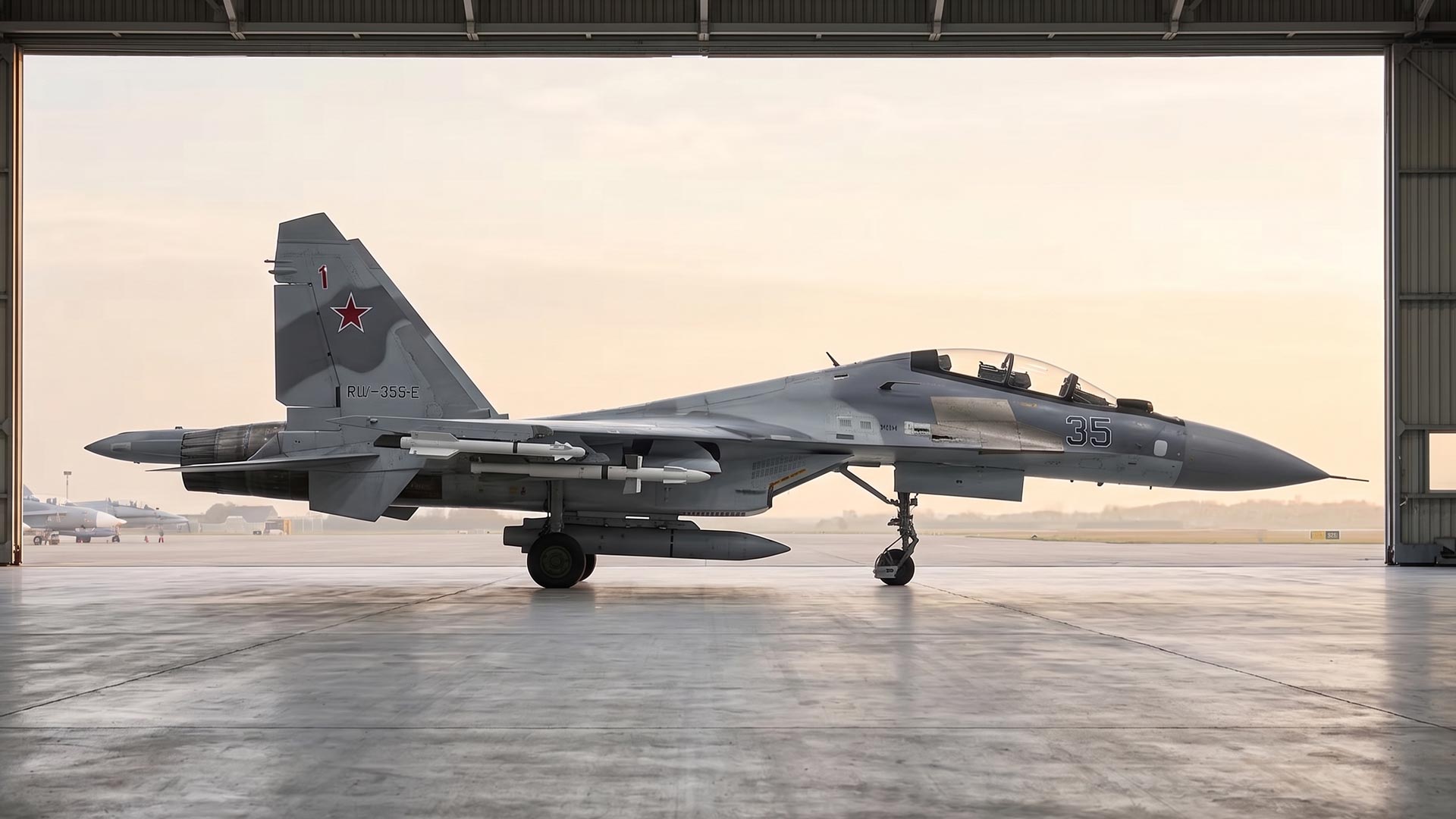
What Is The Su-57 Felon?
The Sukhoi Su-57 Felon. Russia’s advanced 5th-gen stealth fighter. Engineered for agility, speed, and air dominance.
Russia
Origin
Stealth multirole
Role
Mach 2.0
Top speed
20,000 m
Service ceiling
Su-57 Felon Specifications
The Sukhoi Su-57 Felon is a twin-engine fifth-generation multirole stealth fighter designed for tactical air superiority and precision strike missions. Combining its exceptional manoeuvrability, internal weapon storage, and advanced avionics, it represents Russia’s premier aerial combat platform.
Performance
Top speed
2,135 km/h (Mach 2.0/1,325 mph)
Service ceiling
20,000 m (65,600 ft)
Combat radius
1,500 km (internal fuel)/3,500 km (subsonic with external tanks)
Rate of climb
350 m/s (68,900 ft/min)
Airframe
Crew
1
Length
20.1 m (65.9 ft)
Wingspan
14.1 m (46.3 ft)
Empty weight
18,500 kg (40,785 lb)
Engine
2 × NPO Saturn AL-41F1 afterburning turbofans (initial series)
Service
First flight
29 January 2010
Unit cost
Estimated £32 million to £42 million ($42 million to $50 million)
Operators
Russian Aerospace Forces, Algerian Air Force
What Weapons Does The Su-57 Felon Carry?
The Su-57 features two primary internal main weapons bays and two secondary wing-root bays designed to preserve its low radar cross-section. It carries a lethal suite of long-range air-to-air missiles, anti-ship ordnance, and precision-guided standoff munitions for multi-role engagements.
Weapon
Category
Loadout
Range
Gryazev-Shipunov GSh-30-1
Category
Cannon
Loadout
1 × 30 mm (150 rounds)
Range
1.8 km
R-77M (AA-12 Adder)
Category
Air-to-air missile
Loadout
Up to 4 (internal)
Range
190 km
R-74M2 (AA-11 Archer)
Category
Air-to-air missile
Loadout
Up to 2 (internal wing roots)
Range
50 km
R-37M (AA-13 Arrow)
Category
Air-to-air missile
Loadout
Up to 4 (internal/external)
Range
300 km
Kh-59MK2 / Kh-69
Category
Stealth cruise missile
Loadout
Up to 4 (internal)
Range
290 km to 400 km
Kh-58UShKE
Category
Anti-radiation missile
Loadout
Up to 4 (internal)
Range
245 km
KAB-500S-E
Category
Precision bomb
Loadout
Up to 4 (internal/external)
Range
Standoff glide
Category
Loadout
Range
Category
Loadout
Range
Category
Loadout
Range
Category
Loadout
Range

How Fast Is The Su-57 Felon?
Ranking among the fastest modern air superiority fighters, this aircraft, the Su-57 Felon has reached an official maximum speed of Mach 2.0 (approximately 2,135 km/h or 1,325 mph) at high altitudes. A core performance feature of the Su-57 is its capability to achieve "supercruise" – sustaining supersonic flight at speeds around Mach 1.3 without activating its afterburners, drastically reducing fuel consumption during transit, allowing maintenance of high-speed intercepts across vast combat radii without sacrificing its range. At lower altitudes, the airframe retains exceptional structural integrity, travelling at sea-level speeds exceeding 1,400 km/h (Mach 1.15). Driven by dual NPO Saturn AL-41F1 afterburning turbofans, it produces over 14,500 kgf of thrust per engine and accelerates from subsonic cruising speeds to supersonic velocities within seconds.

How Was The Su-57 Felon Developed?
The development of the Su-57 originated in 1999 under the Russian Defence Ministry's PAK FA (Prospective Aeronautical Complex of Frontline Aviation) programme, created to replace ageing MiG-29 and Su-27 fleets. Designated internally as the Sukhoi T-50, the project aimed to field a fifth-generation multirole platform capable of matching Western counterparts like the F-22 Raptor. Sukhoi integrated experimental technologies previously tested on the forward-swept wing Su-47 prototype, focusing on composite airframes, thrust-vectoring engines, and low radar-observability. The T-50 completed its maiden flight on 29 January 2010 at Komsomolsk-on-Amur. However, the development path faced severe hurdles, including structural redesigns, avionics delays, engine production setbacks, and the withdrawal of India from the joint FGFA export initiative. After extensive redesigns and testing under the designation Su-57, the first serial production model was formally delivered to the Russian Military in late 2020.

Has The Su-57 Felon Seen Combat?
The Su-57 has seen limited active deployment in operational combat environments. Russia first tested prototype variants in 2018 by conducting short operational trials at Hmeimim Air Base in Syria, performing brief strikes with standoff precision weapons. Following the outbreak of the Russo-Ukrainian War, the aircraft was deployed for standoff combat operations. Russian forces have utilised the jet primarily from within Russian airspace to launch long-range precision munitions – such as Kh-59MK2 and Kh-69 stealth cruise missiles – against fortified defence systems and infrastructure. In August 2026, state export officials formally acknowledged the jet’s involvement in long-range aerial engagements using advanced air-to-air missiles over Ukraine. Due to high replacement costs and production constraints, Russian commanders have kept the Su-57 clear of heavily defended enemy airspace, choosing standoff precision strikes over direct overflights.
Who Operates The Su-57 Felon?
The primary operator of the Su-57 is the Russian Aerospace Forces (VKS), which integrated the aircraft into service in December 2020. The majority of active airframes are assigned to specialised flight-testing centres and front-line aviation regiments based in the Southern and Western Military Districts. In late 2024, Algeria became the first international customer for the platform after signing a deal for the Su-57E export variant, taking initial deliveries for testing and training. Russia's United Aircraft Corporation (UAC) remains contracted to deliver 76 production-standard units to the VKS. Additionally, Russia continues to market the export-variant Su-57E aggressively across defence markets in Asia, North Africa, and the Middle East as an alternative to Western fifth-generation fighters.
Su-57 Felon FAQs
Common questions about the Su-57 Felon, its capabilities and whether civilians can fly it.
Can a civilian fly in the Su-57 Felon?
No, the Su-57 Felon is a frontline fifth-generation military aircraft and is not available for public commercial flights. Civilian adventure flights are restricted to specific demilitarised jet trainers, such as the L-39 Albatros, or select supersonic interceptors managed by licensed flight operators.
Can I take the controls of the Su-57 Felon?
No, you cannot take the controls of the Su-57 Felon, because it is a single-seat frontline combat aircraft with no secondary cockpit controls for passengers or uncertified personnel. On authorised civilian flights in dual-control trainers such as the L-39, passengers may be allowed to control the aircraft at altitude under direct instructor supervision.
How much does a flight in the Su-57 Felon cost?
You cannot book a flight in the Su-57 Felon, because civilians cannot fly it and its operation is funded entirely by defence budgets, at an estimated cost of several thousand pounds per flight hour. Jetify flights in jets such as the L-39 Albatros start from around £2,500, $3,300 or €2,900, and true supersonic flights in high-altitude aircraft cost considerably more.
Is there a weight or height limit to fly in the Su-57 Felon?
The Su-57 Felon is not open to civilians, but all military jet flight experiences enforce strict height and weight limits for safety and ejection seat clearance. Passengers typically must weigh under 108 kg (17 stone/240 lbs) and stand between 150 cm (4’11”) and 193 cm (6’4”). These limits ensure proper harness fit and safe clearance from the instrument panel during ejection.
How much G-force does the Su-57 Felon pull?
The Su-57 Felon can pull up to 9G, so its pilots wear specialised anti-G suits and use specific breathing techniques to prevent G-induced loss of consciousness (G-LOC). During aerobatic or combat manoeuvres on a civilian jet experience, participants typically feel between 3G and 6G, or three to six times the force of gravity.
How far ahead should I book a jet flight instead of the Su-57 Felon?
The Su-57 Felon cannot be booked, but civilian fighter jet experiences in other aircraft generally need booking 2 to 6 months in advance because of strict pilot scheduling, airworthiness inspections, security vetting and airspace clearances. Booking early also leaves time for medical checks and allows for seasonal weather availability.

Explore the database