What Is The F-47?
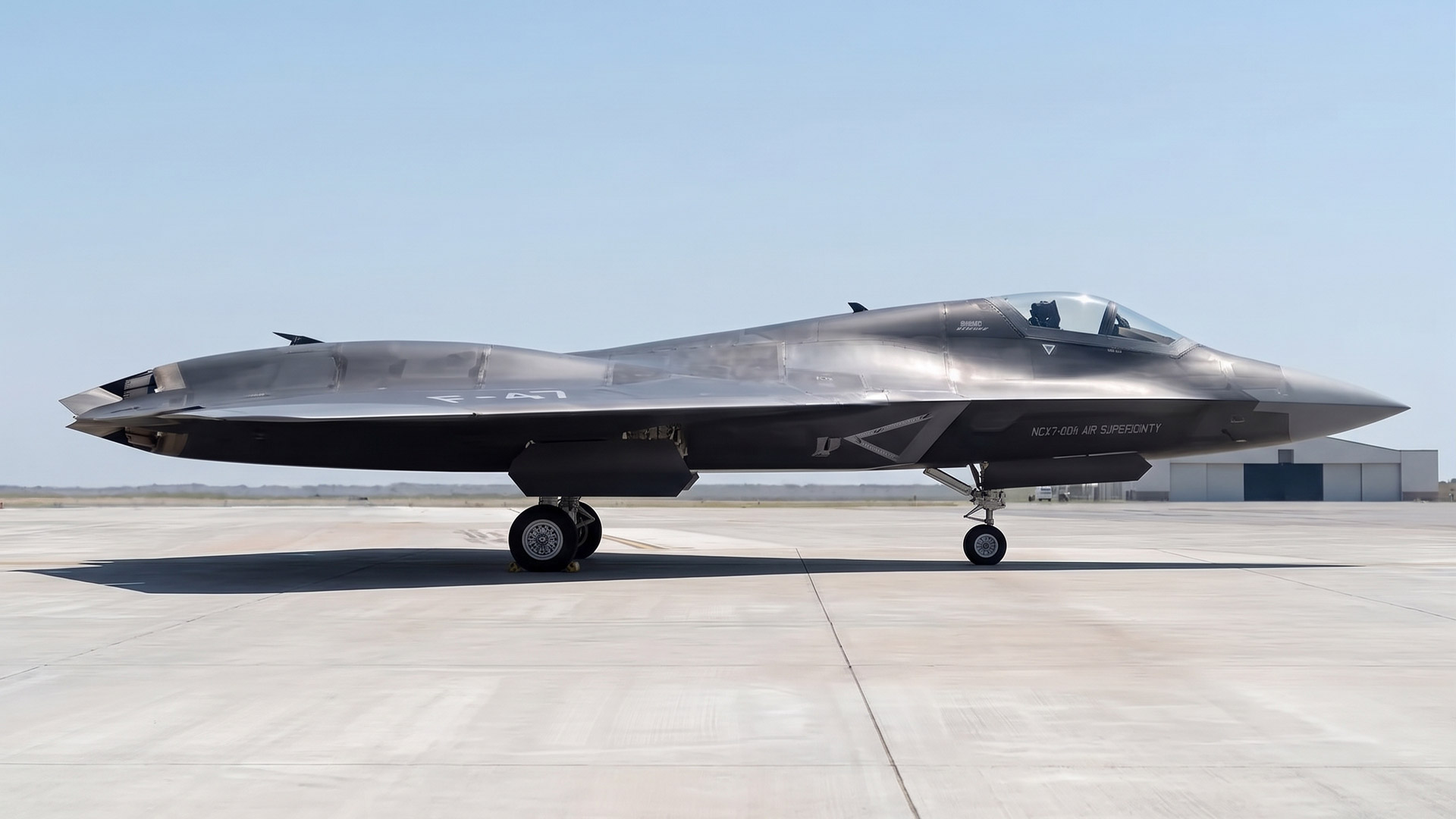
The Boeing F-47. America’s premier 6th-gen air superiority fighter, engineered for long-range stealth and total domain dominance.
United States
Origin
6th gen fighter
Role
Mach 2.0
Top speed
18,288 m
Service ceiling
F-47 Specifications
The Boeing F-47 is a sixth-generation air superiority fighter developed under the Next Generation Air Dominance (NGAD) initiative to replace the F-22 Raptor, integrating multispectral stealth, an extreme unrefuelled range, and collaborative drone integration.
Performance
Top speed
Greater than Mach 2.0 (approx. 1,534 mph/2,470 km/h)
Service ceiling
Classified (Estimated >60,000 ft/18,288 m)
Combat radius
Exceeding 1,000 nautical miles (1,150 miles/1,852 km)
Rate of climb
Classified (High-thrust vectoring capability)
Airframe
Crew
1 Pilot (with AI-driven Collaborative Combat Aircraft integration)
Length
Classified (Estimated 19–21 metres/62–69 feet)
Wingspan
Classified (Advanced stealth delta-wing concept layout)
Empty weight
Classified (Estimated 18,000–22,000 kg/39,600–48,500 lbs)
Engine
Next-Generation Adaptive Propulsion (NGAP) variable-cycle engines
Service
First flight
Expected 2028 (Experimental X-plane predecessors flew in 2019 and 2022)
Unit cost
Estimated $300 million USD (£228 million GBP) per airframe
Operators
United States Air Force (USAF)
What Weapons Does The F-47 Carry?
The F-47 features a fully internal weapons bay designed to preserve extreme radar stealth while delivering long-range munitions. Built with an open mission architecture, it can deploy next-generation air-to-air missiles, precision strike munitions, and direct energy energy payloads alongside autonomous Collaborative Combat Aircraft (CCA).
Weapon
Category
Loadout
Range
AIM-260 JATM (Joint Advanced Tactical Missile)
Category
Air-to-Air Missile
Loadout
6 to 8 internal bay stations
Range
200+ km (124+ miles)
AIM-120D AMRAAM
Category
Air-to-Air Missile
Loadout
6 to 8 internal bay stations
Range
160+ km (100+ miles)
AIM-9X Sidewinder
Category
Short-Range Air-to-Air Missile
Loadout
2 internal side bay stations
Range
35 km (22 miles)
SiAW (Stand-in Attack Weapon)
Category
Air-to-Surface / Anti-Radiation
Loadout
2 to 4 internal bay stations
Range
300+ km (186+ miles)
GBU-53/B StormBreaker (SDB II)
Category
Precision Bomb
Loadout
Up to 8 internal bay stations
Range
110 km (68 miles)
Direct Energy Weapons (Laser System)
Category
Tactical Energy Weapon
Loadout
Integrated internal pod / system
Range
Short to Medium (Line of Sight)
Category
Loadout
Range
Category
Loadout
Range
Category
Loadout
Range
Category
Loadout
Range
Category
Loadout
Range
How Fast Is The F-47?
The Boeing F-47 is engineered to operate comfortably in excess of Mach 2.0 (more than twice the speed of sound, or roughly 2,470 km/h/1,535 mph), with analytical military projections indicating potential dash capabilities approaching Mach 2.9. High speed is critical to the F-47’s mission portfolio; it allows the platform to rapidly intercept high-value adversary assets, reduce engagement timelines across massive operational theatres such as the Indo-Pacific, and evade hostile counter-air systems. Powered by Next Generation Adaptive Propulsion (NGAP) engines, the fighter dynamically transitions between maximum thrust modes for supersonic dash and fuel-efficient turbofan modes for sustained high-speed supercruise without reliance on fuel-heavy afterburners.
How Was The F-47 Developed?
Development of the F-47 originated under the US Air Force's Next Generation Air Dominance (NGAD) initiative, which began in 2014 following DARPA's Aerospace Innovation Initiative. To derisk the revolutionary architecture required for a sixth-generation platform, Boeing and Lockheed Martin constructed full-scale secret X-plane demonstrator aircraft, which conducted extensive flight tests between 2019 and 2022. Operating as part of a "family of systems," the design focused heavily on open digital architecture, extreme low-observable stealth, and seamless integration with semi-autonomous Collaborative Combat Aircraft (CCA) drones. On 21 March 2025, Boeing was officially awarded the Engineering and Manufacturing Development (EMD) contract valued at over $20 billion (£15.2 billion). Official manufacturing of the first operational development airframes commenced shortly thereafter, aiming for a maiden flight by 2028.
Has The F-47 Seen Combat?
The Boeing F-47 has not seen combat. As an ultra-advanced sixth-generation fighter jet currently undergoing engineering and manufacturing development, the aircraft remains in its prototype production phase with flight tests scheduled for 2028. While experimental X-plane technology demonstrators linked to the programme accumulated hundreds of secretive flight hours between 2019 and 2025 to validate stealth and autonomous systems, these test flights occurred strictly within controlled evaluation airspace. The F-47 is not projected to reach initial operational capability (IOC) or be deployed into real-world combat environments until the 2030s.
Who Operates The F-47?
The F-47 is strictly operated by the United States Air Force (USAF). Developed as a highly classified strategic asset to succeed the Lockheed Martin F-22 Raptor, the platform is tailored specifically to preserve American air superiority in heavily contested environments. Due to the extreme sensitivity of its sixth-generation technological suite – including adaptive cycle engines, advanced low-observable coatings, cyber-resilient sensor networks, and autonomous drone command systems – the F-47 is heavily protected under US export restrictions. The USAF plans to procure a fleet of at least 185 production aircraft, with no foreign military sales (FMS) or international operators authorised.
F-47 FAQs
Common questions about the F-47, its capabilities and whether civilians can fly it.
Can a civilian fly in the F-47?
No, civilian or public flights in the Boeing F-47 are impossible. The F-47 is a highly classified sixth-generation military fighter owned exclusively by the United States Air Force, and flight access is restricted to active-duty, highly vetted USAF fighter pilots undergoing specialised tactical evaluation.
Can I take the controls of the F-47?
No, civilians cannot take the controls of the F-47, an active US Air Force air dominance fighter, under US defence law and security protocols. Flying it requires top-secret security clearance, years of military jet training and complex physiological preparation, and the F-47 relies heavily on AI-assisted digital flight controls and semi-autonomous systems.
How much does a flight in the F-47 cost?
You cannot buy a flight in the F-47, because civilians cannot fly it. Each F-47 has an estimated acquisition cost of approximately $300 million (£228 million), and operational flight costs are expected to exceed $40,000 to $60,000 (£30,000 to £45,000) per hour. Jetify flights in demilitarised trainer jets such as the L-39 Albatros start from around £2,500, $3,300 or €2,900.
Is there a weight or height limit to fly the F-47?
Yes, military pilots flying high-performance fighters like the F-47 must meet strict size limits for safe ejection seat clearance and cockpit reach. Generally, military jet pilots must be between 162 cm (5’4”) and 193 cm (6’4”) tall and weigh between 64 kg (140 lbs) and 105 kg (230 lbs) to operate emergency escape systems safely.
How much G-force does the F-47 pull?
F-47 pilots experience forces between +9G and -3G during operational manoeuvres. At +9G the body feels nine times heavier than normal, forcing blood away from the brain towards the feet, so military pilots undergo extensive centrifuge training and wear specialised anti-G suits to prevent G-induced loss of consciousness (G-LOC).
How far in advance can I book an F-47 flight?
You cannot book an F-47 flight, because it is an active military weapon system rather than a commercial or public experience. Legal civilian fighter jet experiences in permitted vintage or trainer aircraft typically need booking 3 to 6 months in advance, due to strict airspace permissions, pilot availability and maintenance scheduling.
Explore the database