What Is The U-2 Dragon Lady?
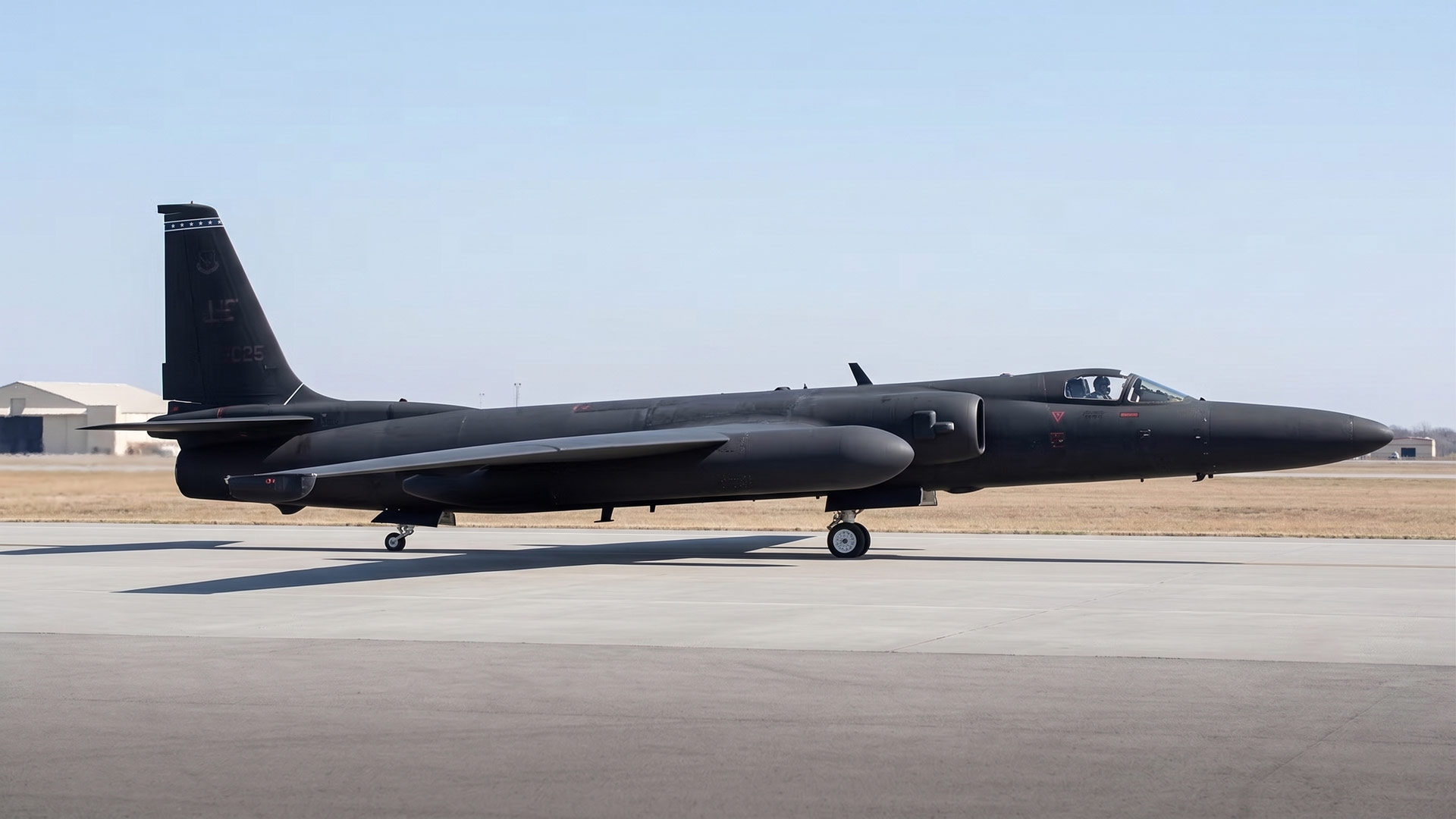
The U-2 Dragon Lady. A high-altitude reconnaissance aircraft providing critical intelligence from above 70,000 feet for decades.
United States
Origin
High-altitude recon
Role
Mach 0.67
Top speed
21,300 m
Service ceiling
U-2 Dragon Lady Specifications
The Lockheed U-2 Dragon Lady is a high-altitude reconnaissance aircraft, capable of sustained flight above 70,000 feet. The aircraft is powered by a single General Electric F118 engine, with wide glider-like wings that allow it to gather multi-sensor intelligence and imagery along international borders.
Performance
Top speed
500 mph (Mach 0.67)
Service ceiling
70,000+ ft (21,300 m)
Combat radius
1,500+ nmi (2,800+ km)
Rate of climb
15,000 ft/min (76 m/s)
Airframe
Crew
1
Length
63 ft 0 in (19.20 m)
Wingspan
105 ft 0 in (32.00 m)
Empty weight
16,000 lbs (7,250 kg)
Engine
1x General Electric F118-GE-101 non-afterburning turbofan
Service
First flight
1 August 1955
Unit cost
$9.5 million
Operators
United States (USAF, NASA)
What Weapons Does The U-2 Dragon Lady Carry?
The U-2 Dragon Lady is a completely unarmed high-altitude intelligence platform equipped with high-resolution cameras, synthetic aperture radar, electro-optical sensors, and electronic intelligence gathering pods.
Weapon
Category
Loadout
Range
SYERS-2C
Category
Electro-Optical Sensor
Loadout
1 nose-mounted unit
Range
Long-range oblique imaging
ASARS-2A
Category
Synthetic Aperture Radar
Loadout
1 nose-mounted unit
Range
Over 160 km (100 miles)
Senior Glass
Category
Signals Intelligence Suite
Loadout
Wing pod mounted
Range
Line of sight from altitude
Optical Bar Camera
Category
Wet-Film Panoramic Camera
Loadout
1 payload bay unit
Range
Wide-area imaging
Category
Loadout
Range
Category
Loadout
Range
Category
Loadout
Range
Category
Loadout
Range
Category
Loadout
Range
Category
Loadout
Range
Category
Loadout
Range
How Fast Is The U-2 Dragon Lady?
The U-2 is subsonic, cruising at roughly 500 mph. Speed is irrelevant to its mission; altitude is everything. Above 70,000 feet the aircraft operates in what pilots call coffin corner, where the margin between stall speed and maximum speed narrows to just a few knots. Pilots wear full pressure suits, and the aircraft is notoriously difficult to land, requiring a chase car to call out height.
How Was The U-2 Dragon Lady Developed?
Lockheed's Clarence Kelly Johnson designed the U-2 in response to a CIA requirement for an aircraft that could overfly the Soviet Union above the reach of its interceptors and missiles. Development was extraordinarily fast: the first flight took place on 1 August 1955, just eight months after approval. The glider-like wing and stripped-out structure produced an aircraft that could reach altitudes nothing else could touch.
Has The U-2 Dragon Lady Seen Combat?
The U-2 has flown reconnaissance over the Soviet Union, Cuba, Vietnam, the Middle East, the Balkans, Iraq and Afghanistan. Gary Powers was shot down over Sverdlovsk in 1960, triggering a major diplomatic incident, and U-2 imagery identified Soviet missile sites in Cuba in 1962. It remains in active service, repeatedly outliving proposed replacements.
Who Operates The U-2 Dragon Lady?
The United States Air Force operates the fleet from Beale Air Force Base in California, with NASA flying two examples for earth science. Retirement has been proposed and deferred several times; current plans extend service into the 2030s.
U-2 Dragon Lady FAQs
Common questions about the U-2 Dragon Lady, its capabilities and whether civilians can fly it.
Can I fly in the U-2 Dragon Lady as a civilian?
No, the U-2 Dragon Lady is not available for civilian passenger flights. Jetify offers flights in ex-military aircraft that have been demilitarised and placed on a civil register, such as the L-39 Albatros, Hawker Hunter and MiG-15 Fagot, across 7 aircraft types from 11 airfields in 7 countries.
Can I take the controls of the U-2 Dragon Lady?
No, you cannot take the controls of the U-2 Dragon Lady, because it is not available for civilian passenger flights. On the aircraft Jetify does operate, such as the L-39 Albatros, most allow you to take the controls in level flight and gentle turns once your pilot is satisfied you are comfortable.
How much does a flight in the U-2 Dragon Lady cost?
The U-2 Dragon Lady is not available for civilian passenger flights, so there is no price for a flight in one. Jetify flights in jets such as the L-39 Albatros start from around £2,500, $3,300 or €2,900, while the MiG-15 Fagot, Aermacchi S.211 and Lockheed T-33 start from around £2,800 ($3,800, €3,400). The Hawker Hunter, the fastest aircraft currently bookable, starts from around £6,400, $8,500 or €7,600. Every price is per person and includes ground school, flight suit, helmet and pre-flight medical screening.
Are there weight limits on a jet flight instead of the U-2 Dragon Lady?
The U-2 Dragon Lady is not available for civilian passenger flights, but all jet flight experiences enforce strict height and weight limits set by ejection seat clearances, cockpit dimensions and harness fit. Height is typically 5ft 2in (157 cm) to 6ft 4in (193 cm), and weight is generally capped at 16 st 7 lb to 18 st 12 lb (105 kg to 120 kg) depending on the aircraft. You also need normal cardiovascular health, with no heart conditions, severe high blood pressure or recent surgery.
How much G-force would I feel on a jet flight instead of the U-2 Dragon Lady?
The U-2 Dragon Lady is not available for civilian passenger flights, but on a civilian jet experience aerobatic profiles typically reach four to eight positive G in sustained turns and around minus four negative G. You learn the anti-G straining manoeuvre in ground school, which keeps you conscious under load. Supersonic and high-altitude profiles are physically far easier, and what happens in the air is agreed with your pilot and can be adjusted at any point.
How far in advance should I book a jet flight instead of the U-2 Dragon Lady?
The U-2 Dragon Lady is not available for civilian passenger flights, but you should book a real ex-military jet experience, such as the L-39 Albatros, 2 to 4 months in advance because of limited aircraft availability, maintenance schedules and airspace clearances. For weekend slots in peak summer months, allow 6 months. Simulator experiences generally need 2 to 3 weeks’ notice for standard weekend bookings.
Explore the database