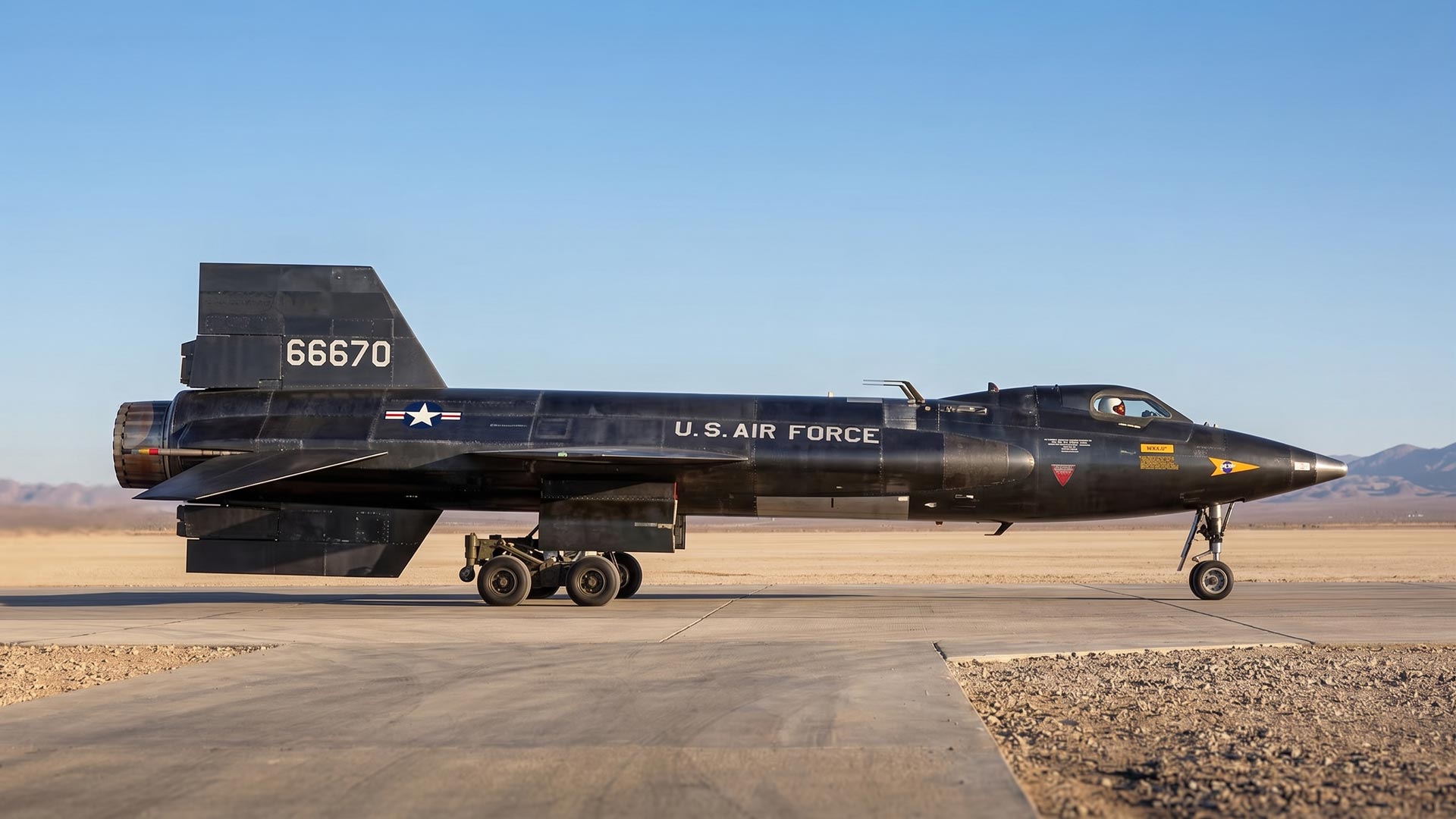
What Is The X-15?
The X-15. A North American hypersonic research plane, reaching record-breaking speeds of Mach 6.72 and even briefly crossed the boundary into space.
United States
Origin
Rocket research aircraft
Role
Mach 6.72
Top speed
107,960 m
Service ceiling
X-15 Specifications
The North American X-15 was a purely experimental, rocket-powered hypersonic research aircraft built to bridge atmospheric flight and outer space. Operated by NASA and the US Air Force, it pioneered reaction controls, heat-resistant materials, and high-altitude human spaceflight.
Performance
Top speed
Mach 6.72 (4,520 mph/7,274 km/h)
Service ceiling
354,200 feet (67 miles/107.8 km)
Combat radius
Not Applicable (Pure experimental research aircraft)
Rate of climb
60,000 feet per minute (approximate powered vertical climb)
Airframe
Crew
1
Length
50 feet 9 inches (15.5 metres)
Wingspan
22 feet 4 inches (6.8 metres)
Empty weight
14,600 lbs (6,620 kg)
Engine
1 × Reaction Motors XLR99-RM-2 liquid-propellant rocket engine (57,000 lbf/254 kN thrust)
Service
First flight
8 June 1959 (Unpowered glide flight); 17 September 1959 (First powered flight)
Unit cost
Approximately $300 million USD (Total programme cost across 3 built aircraft)
Operators
NASA, United States Air Force, United States Navy
What Weapons Does The X-15 Carry?
The North American X-15 was entirely a non-combat, experimental research platform designed purely to investigate aerodynamic heating, high-altitude stability, and hypersonic flight dynamics. It carried no offensive or defensive armaments, hardpoints, or internal weapon bays throughout its operational lifespan.
Weapon
Category
Loadout
Range
None
Category
N/A
Loadout
None
Range
N/A
Category
Loadout
Range
Category
Loadout
Range
Category
Loadout
Range
Category
Loadout
Range
Category
Loadout
Range
Category
Loadout
Range
Category
Loadout
Range
Category
Loadout
Range
Category
Loadout
Range
Category
Loadout
Range
How Fast Is The X-15?
The North American X-15 remains the fastest crewed, powered aircraft in human history, setting an absolute world record that stands unbroken to this day. On 3 October 1967, pilot William "Pete" Knight achieved a top speed of Mach 6.72 – equivalent to 4,520 miles per hour (7,274 km/h) – while flying the heavily modified X-15A-2 variant at an altitude of 102,100 feet. At these hypersonic velocities, the aircraft flew faster than a rifle bullet, generating atmospheric friction hot enough to melt standard aircraft metals. To survive the extreme thermal stresses exceeding 650°C (1,200°F), the X-15 airframe was constructed from Inconel X, a specialised nickel-chromium superalloy, and coated with an ablative thermal protection material for maximum-speed test runs.
How Was The X-15 Developed?
Development of the X-15 began in December 1954 under a joint initiative managed by the National Advisory Committee for Aeronautics (NACA, later NASA), the United States Air Force, and the United States Navy. The objective was to construct a research vehicle capable of exploring the uncharted flight envelope of Mach 4 to Mach 7 and reaching altitudes up to 50 miles above the Earth. In September 1955, North American Aviation was awarded the contract to build three aircraft airframes, while Reaction Motors was selected to develop the revolutionary XLR99 rocket engine – the first human-rated, fully throttleable rocket motor. Because the X-15 consumed fuel at an enormous rate (burning its entire propellant supply of liquid oxygen and anhydrous ammonia in under 90 seconds), it could not take off under its own power. Engineers designed it to be air-launched from beneath the wing of a modified Boeing NB-52 mothership at an altitude of 45,000 feet, allowing the aircraft to conserve its rocket fuel exclusively for accelerating into hypersonic speeds and climbing past the atmosphere.
Has The X-15 Seen Combat?
The X-15 never saw combat and was never intended for military engagements. It was strictly an experimental X-plane built exclusively for scientific research and aerospace technology development. No combat avionics, target acquisition systems, or weapons storage were ever integrated into its airframe. Instead of tactical missions, its 199 total flights between 1959 and 1968 were structured around collecting critical data on thermal heating, hypersonic aerodynamics, human physiological response to weightlessness, and reaction control manoeuvring outside Earth's atmosphere. The discoveries made during the X-15 programme laid the essential foundation for American space exploration, directly contributing to the structural and operational designs of the Mercury, Gemini, Apollo, and Space Shuttle programmes.
Who Operates The X-15?
The X-15 was jointly operated by NASA (National Aeronautics and Space Administration) and the United States Air Force, with technical support from the United States Navy and contractor North American Aviation. A total of only 12 elite test pilots flew the aircraft during its nine-year operational history, including legendary figures such as Neil Armstrong (the first human to walk on the Moon), Joseph Walker, and Robert White. Because the X-15 flew well above the 50-mile (80 km) altitude threshold recognised by the United States for the boundary of space, eight of these pilots earned official military Astronaut Wings during their X-15 flights. Today, the aircraft is completely retired; no active operator flies the X-15. The surviving airframes are permanently displayed at the Smithsonian National Air and Space Museum in Washington, D.C., and the National Museum of the United States Air Force in Dayton, Ohio.
X-15 FAQs
Common questions about the X-15, its capabilities and whether civilians can fly it.
Can I experience a flight in the X-15?
No, it is impossible to fly in the X-15. Only three were built, the joint NASA/USAF flight test programme ended in December 1968, and the two survivors are retired museum exhibits. The X-15 was a single-seat rocket plane needing extensive astronaut training, full-pressure suits and a modified B-52 mothership, so passenger flights never existed.
Can I take the controls of the X-15?
No, members of the public cannot take the controls of the X-15, which is now a non-operational static museum exhibit. Only 12 highly specialised military and NASA test pilots ever flew it, managing aerodynamic surfaces in the atmosphere and hydrogen-peroxide reaction control thrusters at the edge of space, making it one of aviation’s most demanding aircraft.
How much did a flight in the X-15 cost?
You could never buy a flight in the X-15, because the experimental spaceplane was never available for commercial purchase or private charter. Its total research and development programme cost approximately $300 million in the 1950s and 1960s, equivalent to over $2.5 billion today, funded entirely by the US government. Jetify flights in jets such as the L-39 Albatros start from around £2,500, $3,300 or €2,900.
Was there a weight or height limit to fly the X-15?
Yes, X-15 pilots faced strict USAF and NASA physical limits, because they had to fit a tight, custom-contoured single-seat cockpit while wearing a bulky MC-2 full-pressure suit. Height was generally under 6 feet (183 cm) and weight under 180 lbs (82 kg), for safe ejection clearance and the precise mass-and-balance envelope of hypersonic rocket flight.
How much G-force did the X-15 pull?
X-15 pilots routinely experienced +5G to +7G during powered acceleration climbs and atmospheric re-entry pull-outs. On extreme trajectories, the XLR99 rocket engine burned 15,000 pounds of propellant in under 90 seconds, followed by complete weightlessness (0G) while coasting above the atmosphere at altitudes higher than 300,000 feet.
Do I need to book in advance to see the X-15?
You cannot book a flight on the X-15, but you can see it without advance booking. The X-15-1 is on permanent display at the Smithsonian National Air and Space Museum in Washington, D.C., and the X-15A-2 at the National Museum of the United States Air Force in Dayton, Ohio. Both museums are open to the public year-round.
Explore the database